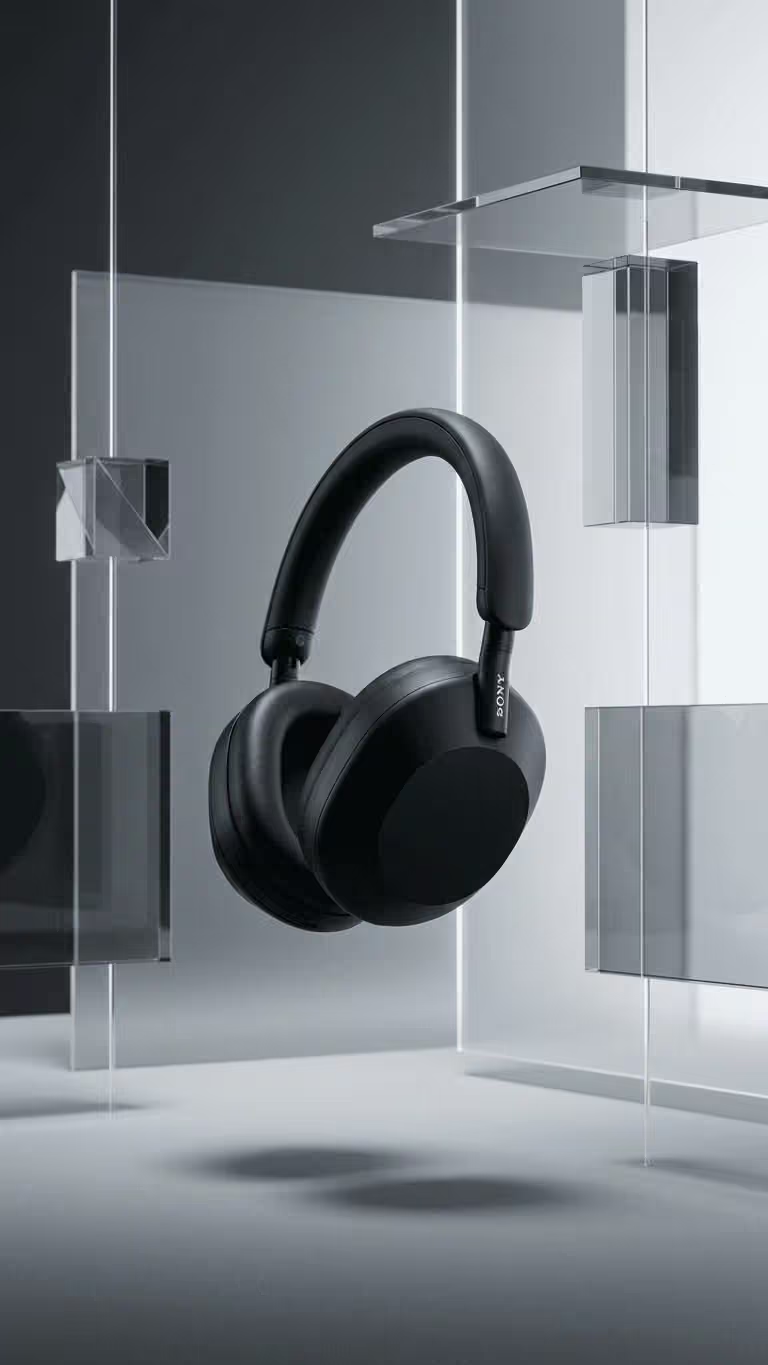
Quick Verdict
The Sony WH-1000XM5 was Sony's flagship noise-cancelling headphone before the release of its successor, the WH-1000XM6, and it remains one of the strongest active noise cancellation (ANC) performers on the market today.
Buyers who want top-tier ANC below the launch price, frequent travelers, heavy call users, and anyone who prefers a punchy, bass-forward sound signature.
Anyone concerned about long-term hinge durability, or buyers who want the newest generation with the best available sound quality (XM6 is the better fit there).
Excellent ANC confirmed across multiple independent tests, strong call quality, solid battery life.
Recurring reports of the headband hinge breaking after extended use, often outside the warranty window.
Since the WH-1000XM6 is now the current generation, the XM5 is frequently discounted, which can make it a strong value pick when it isn't at full price.
Price & Availability
Prices and deals change constantly. Always check the current price on Amazon before buying.
At launch in May 2022, Sony set the price at $399.99, up from the previous generation's $350 price point. This is the official list price that still appears on the product page at times.
Since the release of the newer WH-1000XM6 (launched around $449–$458), the XM5 has regularly gone on sale at steep discounts. For example:
- Prime Day 2026 coverage reported the price dropping to a record-low $198, a discount of more than $200.
- In March 2026, the price fell to $243 as part of an Amazon spring sale, a 39% discount.
- In May 2026, another price point was documented at roughly $248 (about $152 off).
These figures reflect past deals only and are not guaranteed to be available now — check the current price and availability on Amazon's product page before purchasing. YallaBuy cannot confirm any discount or "limited-time" claim at the moment you're reading this.
Pros & Cons
✓ Pros
- Among the strongest ANC performance in its class, according to multiple independent tests.
- Strong call quality; Tom's Guide described it as "stellar call quality".
- Relatively long battery life for an ANC headphone.
- LDAC support and Hi-Res Audio for higher-quality listening over Bluetooth.
- Extensive sound customization through the Sony Headphones Connect app's EQ.
✗ Cons
- Recurring complaints about the headband hinge cracking after roughly a year of normal use.
- TechGearLab found battery life shorter than expected, calling it "disappointing".
- Some reviews noted the headphones can get warm around the ears during longer sessions.
- No official water-resistance rating, flagged by TechRadar as a drawback.
Official Specifications
Source: Sony's official support pages.
| Weight | Approx. 250g |
| Driver type | Closed, dynamic |
| Driver size | 30mm, custom-designed |
| Bluetooth version | Bluetooth 5.2 |
| Supported codecs | SBC, AAC, LDAC |
| Battery life (ANC on) | Up to 30 hours |
| Battery life (ANC off) | Up to 40 hours |
| Full charge time | Approx. 3.5 hours via USB |
| Noise-cancelling mics | 8 microphones, up from 4 in the previous generation |
| Processors | Integrated Processor V1 + HD Noise Cancelling Processor QN1 |
| Frequency response (wired) | 4 Hz – 40,000 Hz |
| Wired connection | 3.5mm stereo mini jack, approx. 1.2m cable |
The table above reflects manufacturer claims as officially published, not independent test results. Real-world performance can differ — see the Performance section below.
What Makes the XM5 Different?
The biggest change from the XM4 to the XM5 is the noise-cancellation system. Sony claims the headphones use two processors controlling eight microphones to dramatically reduce noise, especially in the mid-to-high frequency range, compared to four microphones on the XM4. The headphones also add "Auto NC Optimizer," which, according to What Hi-Fi, automatically fine-tunes noise cancellation as you move around, instead of requiring a manual calibration step like earlier generations.
On the sound side, What Hi-Fi's award coverage noted Sony achieved a meaningful jump in sound quality over the previous generation despite a full redesign.
Main Features Explained
Active Noise Cancellation (ANC)
What is it?
A technology that uses microphones to pick up ambient noise and generate an inverse sound wave to cancel it out.
How it works here: Sony states the headphones use eight microphones working with two dedicated processors, with automatic tuning based on environment.
Why it matters: It's the single biggest factor for anyone using the headphones on flights, public transit, or in noisy offices.
Limitations: According to SoundGuys, real-world results can vary based on fit, and a Reddit user's investigation found that a poor fit was the main culprit behind underwhelming ANC results for some users.
Ambient Sound Mode
What is it?
A mode that lets external sound through without removing the headphones. According to HeadphonesAddict, Ambient mode performance is very good but not the absolute best, as Apple's AirPods Max slightly edge it out in how naturally they amplify surrounding sound.
Source: HeadphonesAddict
Sound Quality and Customization
Tunable Sound Profile
According to SoundGuys, the headphones offer good sound quality with strong bass and treble emphasis, but a somewhat recessed midrange, meaning they benefit from some EQ adjustment to reach a more balanced profile.
Source: SoundGuys
LDAC and Hi-Res Audio Support
Higher-Quality Bluetooth Audio
Sony's proprietary audio coding technology allows more data to be transmitted over Bluetooth. Per the official spec sheet, LDAC transmits approximately three times more data than conventional Bluetooth audio, improving Hi-Res Audio quality. This requires a compatible device and app to take full advantage of it.
Call Quality
Stellar Calls with One Caveat
Tom's Guide listed call quality as one of the headphones' standout strengths, describing it as "stellar". RTINGS, however, noted real-world limits: your voice will sound clear but will lack fullness, and while the mic separates your voice from background noise well, loud sudden sounds like an arriving subway train can cause your voice to briefly cut out.
Sources: Tom's Guide, RTINGS
Performance: What Independent Testing Found
This section relies entirely on independent lab results, not YallaBuy's own testing.
Noise Cancellation
TechGearLab's testing found strong overall results, blocking as much as 31 decibels of noise, making it one of the best performers for ANC in its category.
Important caveat: The same source found that the actual results did not show a clear improvement specifically in the mid-to-high frequency range that Sony claims, aside from a small bump between 2,000–4,000 Hz — though overall noise blocking across the frequency spectrum was still outstanding. This is a clear conflict between Sony's marketing claim and the independent measurement.
SoundGuys documented that the headphones reduce noise in the frequency range where most music sits by around 30dB, dropping the perceived loudness of engines, trains, and street noise to roughly one-eighth of their original level, with notably better low-end performance than competitors like the Bose QuietComfort 45, Bose 700, and even Sony's own previous-gen XM4.
Sources: TechGearLab, SoundGuys
Battery Life
While Sony claims up to 30 hours with ANC enabled, TechGearLab's real-world testing found battery life closer to 25 hours, a result they described as disappointing relative to competitors and even to other Sony headphones, which typically last closer to 30 hours.
Source: TechGearLab
Sound Consistency
According to RTINGS, the headphones show good frequency response consistency regardless of individual physical differences between listeners, as long as the headphones are seated properly. They also noted that wearing glasses can break the seal and affect real-world results.
Source: RTINGS
Problems & Limitations
This section combines independent test observations with recurring patterns in user reports.
Headband Hinge Breakage
This is the most frequently documented complaint, appearing across multiple sources independent of one another. On Adorama, one buyer described the hinge connecting the headband to each ear cup breaking after about a year of normal household use, and after researching the issue, discovered it was a widely known and common problem — a temporary fix worked for a few weeks before it broke again more than once. Another review on the same platform confirmed the issue, calling it the "notorious hinge issue".
The same pattern appeared in separate tech-deals forum discussions (Slickdeals), where one user warned bluntly that it's not a matter of "if" you'll experience the hinge issue, but "when", while another said they avoided the XM5 specifically because of how often this complaint came up.
What couldn't be verified: There's no official data from Sony on the exact percentage of units affected, so a precise failure rate can't be stated. What is confirmed is that the complaint recurs across multiple independent sources.
Scattered Connectivity Issues
Some Adorama reviewers reported Bluetooth stability problems, such as repeated disconnects during daily use. These reports are less widespread than the hinge complaint, so they're best classified as isolated reports rather than a confirmed pattern.
Warmth Around the Ears
Tom's Guide noted the headphones can get slightly warm around the ears during long sessions — this comes from a single review, and we did not find broad corroboration from other sources.
Comparison With Competitors
vs. Sony WH-1000XM6
Is the Upgrade Worth It?
According to SoundGuys, the XM6 pulls ahead in measurable sound quality, scoring 4.8 out of 10 in their overall MDAQS testing versus 4.2 for the XM5, with clear gains in detail clarity and spatial presentation. Audio46 found the XM6 offers a tighter, more controlled low end that emphasizes texture and nuance rather than sheer bass power.
SoundGuys concluded that the XM6 is the better product overall for most new buyers, but the XM5 remains the better deal — the upgrade decision comes down mostly to budget.
Sources: SoundGuys, Audio46, Tom's Guide
vs. Sony WH-1000XM4
Two Generations Behind, Still Viable
Tom's Guide found the XM5 delivered meaningful upgrades, including better noise cancellation, faster charging, and a sleeker carbon-fiber design compared to the XM4. If budget is extremely tight, the XM4 remains a reasonable pick since it's cheaper, though it's now two generations behind.
Source: Tom's Guide
vs. Bose QuietComfort Ultra
No Clear Winner Without Direct Testing
We didn't find a single comprehensive, directly comparative independent test covering every category. Both are widely regarded as top-tier ANC options, and the Bose QuietComfort Ultra is also frequently discounted to similar price points — the choice often comes down to personal preference in sound signature rather than a clear performance gap.
| Feature | Sony WH-1000XM5 | Sony WH-1000XM6 |
|---|---|---|
| Launch price | $399.99 | $449 |
| Noise-cancelling mics | 8 | More, per Gadget Flow (additional AI-driven processing) |
| Sound quality (MDAQS) | 4.2 out of 10 | 4.8 out of 10 |
| Case design | Zipper case | Magnetic case |
| Current availability | Frequently discounted | Higher-priced flagship |
Who Should Buy It?
Buyers who should consider it
- Want flagship-level ANC below the newer generation's price
- Frequent travelers and public transit commuters
- Need reliable call quality for remote work
- Prefer a bass-forward (V-shaped) sound profile
Buyers who should look elsewhere
- Paying close to full $399 launch price
- Concerned about mechanical failure after warranty expires
- Need water resistance for exercise
- Want a fully neutral sound without EQ
Value for Money
At close to the full $400 launch price, the XM5 becomes harder to justify against the newer, better-sounding XM6 for a relatively small price difference. But since Tom's Guide documented prices as low as $278 during sale periods, and other reports documented drops to roughly $200–$250 during events like Prime Day and spring sales, the value proposition improves significantly when bought on a discount.
Rule of thumb: Don't buy the XM5 near full price if you can afford the small step up to the XM6. But if you find it discounted by roughly 40% or more off the launch price, it remains a strong buy based on the independent testing available.
Final Verdict
Strong ANC, Smart Price — With One Caveat
The Sony WH-1000XM5 still delivers some of the strongest ANC performance available today, confirmed by multiple independent tests with broadly consistent results, along with solid call quality and enjoyable — if slightly V-shaped — sound. The two things most worth weighing before buying are: the recurring hinge-breakage complaints after extended use, and the fact that a newer generation (the XM6) clearly outperforms it on sound quality.
The final call depends heavily on price. At close to full retail, the case leans toward considering the XM6 instead. At a meaningfully discounted price (roughly under $300), the XM5 remains a solid buy based on the available evidence.