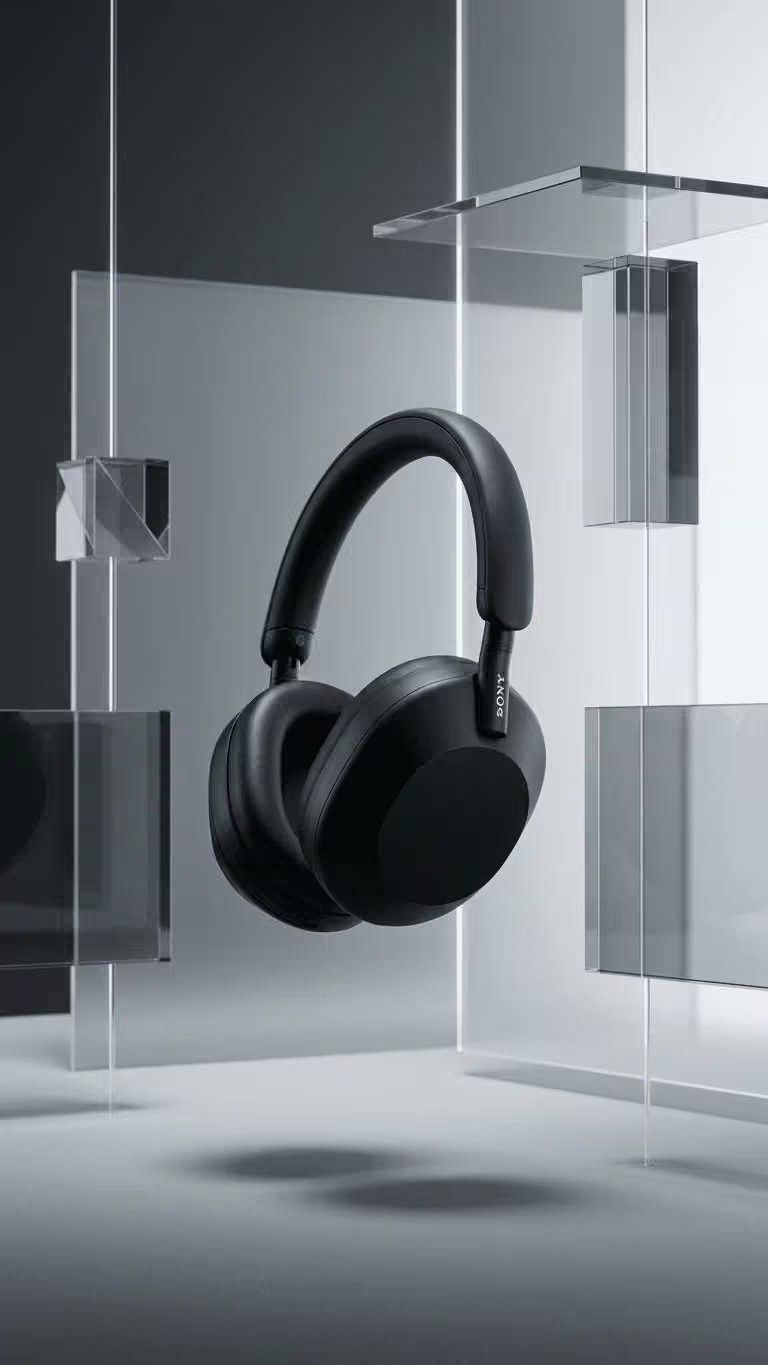
You can spend hundreds of dollars on a premium pair of headphones and still end up paying for features you rarely use. That is why this guide takes a different approach. Instead of simply listing what the Sony WH-1000XM5 can do, we are going to ask a more useful question: Do you actually need this feature?
Some XM5 features can make a huge difference if you travel, work in noisy environments, or switch between a phone and laptop every day. Other features are useful but not important enough to influence your buying decision. And a few features sound impressive in marketing but should not be the reason you buy the headphones.
The goal of this guide is simple: Help you decide whether the Sony WH-1000XM5 is actually worth buying for your lifestyle.
Sony WH-1000XM5: The Short Answer
Before we analyze every feature, here is the quick version. The Sony WH-1000XM5 makes the most sense if you want a premium over-ear headphone for:
- Air travel
- Public transportation
- Office work
- Studying
- Everyday music
- Podcasts and videos
- Phone and video calls
- Long listening sessions
- Switching between a smartphone and computer
- Blocking external noise
It makes less sense if you:
- Mostly listen in quiet rooms
- Do not care about noise cancellation
- Need serious water resistance
- Mainly use headphones for intense workouts
- Want a gaming-first headset
- Want the cheapest possible option
- Already own a good premium ANC headphone and are looking for a major upgrade
And there is one more important consideration. The WH-1000XM5 is no longer Sony's newest flagship over-ear headphone. Sony has released the newer WH-1000XM6, so the XM5's value depends heavily on its current price. That means you should not automatically buy the XM5 simply because it used to be Sony's flagship. The right question is whether the XM5 gives you the features you actually need at a price you are comfortable paying.
1. Active Noise Cancellation: A Feature You May Actually Need
Let's start with the biggest reason many people buy the WH-1000XM5: Active Noise Cancellation. Sony designed the XM5 around advanced noise cancellation, using multiple microphones and dedicated processing to reduce external sounds. This is not just a feature that looks good on the specification sheet. For the right person, ANC can completely change how headphones feel. But whether you need it depends on your environment.
If you travel frequently, this is where the XM5 becomes much easier to recommend. Imagine sitting on an airplane for five hours. You have: Engine noise, Air conditioning, People talking, Passengers moving around, Cabin noise, Children, Announcements. Without ANC, you might increase the volume to cover some of that noise. With good ANC, you can reduce the amount of external noise reaching your ears while listening at a more comfortable volume.
The same idea applies to trains, buses and other transportation. Independent testing has found the XM5's noise isolation and ANC performance particularly effective against low-frequency sounds such as bus and airplane-like noise.
Do you need it? Yes, if you regularly travel or work around noise. If you mostly listen in a quiet bedroom, however, flagship-level ANC becomes much less important.
2. Do You Need ANC If You Mostly Use Headphones at Home?
This is an important question because many people buy expensive ANC headphones without actually needing ANC. If you normally use headphones in a quiet bedroom, a quiet home office, a private study room, or a quiet house, then you are not going to experience the full benefit of the XM5's noise cancellation.
That does not mean ANC is useless. It can still help create a more isolated environment for studying, working or relaxing. But you should not pay a premium just because "ANC" sounds impressive. If your environment is already quiet, the difference between excellent ANC and decent ANC becomes much less important.
3. Sony's Noise-Cancellation Processing: Do You Need to Understand It?
Sony uses several technologies to improve the XM5's noise cancellation, including its HD Noise Cancelling Processor QN1, Integrated Processor V1 and Auto NC Optimizer. Sony says the Auto NC Optimizer adjusts noise-cancellation performance based on factors such as wearing conditions and the surrounding environment. The technology is impressive. But you do not need to understand every processor name to decide whether the headphones are right for you. Think of it this way: You are not buying a processor. You are buying the result. If the result is that your train ride becomes quieter and more comfortable, the technology is doing its job.
4. Sound Quality: This Is a Real Reason to Buy
Noise cancellation is not the only important part of a headphone. The XM5 also delivers strong overall sound quality. Sony uses custom 30 mm drivers and supports several Bluetooth codecs, including SBC, AAC and LDAC. But don't make the common mistake of assuming that bigger technical numbers automatically mean better sound. A 30 mm driver does not automatically make a headphone better than one with a 40 mm driver. What matters is the final tuning and how the headphone sounds to you. The XM5 is designed as an everyday premium headphone rather than a specialized studio monitor. That makes it suitable for a wide range of content: Pop, Hip-hop, Rock, Electronic music, Podcasts, YouTube, Movies, TV shows, Streaming music. For most people, this is exactly what they need.
5. LDAC: Do You Really Need It?
LDAC is one of the features that Sony highlights heavily. Sony describes LDAC as a high-quality Bluetooth audio technology capable of transmitting significantly more data than conventional Bluetooth audio codecs. That sounds great. But here is the question: Will you actually use LDAC? If you have a compatible Android phone and care about maximizing wireless audio quality, LDAC is useful. If you listen to high-quality music files and are interested in wireless audio, it becomes more relevant. But if you mostly watch YouTube, listen to podcasts, use normal streaming, watch TikTok, or listen to casual music, then LDAC should not be high on your buying checklist.
6. Multipoint Bluetooth: One of the Most Useful XM5 Features
This is one of the features that sounds boring until you actually use it. The XM5 supports simultaneous connection to two Bluetooth devices. For example: Laptop + smartphone. You can be listening to something on your laptop and then switch to your phone for a call. Sony specifically supports connecting the headphones to two devices simultaneously and switching between them when necessary. This is extremely useful for remote workers, students, office workers, people who use laptops and phones together, and people who take frequent calls. Imagine working on your laptop. Music is playing. Your phone rings. You answer the call. After the call ends, you go back to your computer. You do not have to manually disconnect and reconnect every time. That is real convenience. But if you only use one device? Then this feature does almost nothing for you.
7. Speak-to-Chat: Smart, But You Probably Don't Need It
Speak-to-Chat sounds futuristic. The idea is simple. You start speaking. The headphones detect your voice and automatically change the audio behavior so you can hear your surroundings. When the conversation ends, playback can resume. It is a clever feature. But clever does not always mean necessary. Sony notes that Speak-to-Chat can sometimes activate unintentionally because of certain sounds or vibrations, including things such as coughing or humming. That means some users will love it. Others will eventually turn it off. If you wear your headphones at work and frequently have short conversations with coworkers, it can be useful. If you rarely talk while wearing your headphones, it is much less important.
8. Ambient Sound Mode: More Important Than It Looks
Everyone talks about ANC. But the opposite feature can be just as important: Ambient Sound. Instead of trying to block the world, the headphones allow external sounds to reach you. This is useful when walking outside, waiting at an airport, working in an office, talking to someone, listening for announcements, or crossing streets. You do not want to remove the headphones every time you need to hear something. That is where Ambient Sound becomes practical. For many people, the combination of ANC + Ambient Sound is much more useful than ANC alone.
9. Quick Attention: A Small Feature That Can Save You Time
Quick Attention is one of those features that doesn't look important until you start using it. Instead of removing the headphones, you can quickly interact with the outside world by changing how much external sound you hear. For example, you're listening to music at a coffee shop. A waiter comes over. You need to hear what they are saying. You do not necessarily need to stop everything and take the headphones off. This is convenience. Not revolutionary technology. But good products are often defined by small conveniences.
10. Wearing Detection: Small Feature, Real Convenience
The XM5 can detect when you remove the headphones and can pause playback automatically. This sounds insignificant. But think about how often you remove your headphones during the day. Someone talks to you. You take them off. Music pauses. You put them back on. Playback resumes. You don't need to reach for your phone. This is not a feature you should pay hundreds of dollars for by itself. But once it is there, it makes everyday use smoother.
11. Adaptive Sound Control: Do You Want Your Headphones to Make Decisions for You?
Adaptive Sound Control is designed to automatically adjust sound and ambient settings based on your activity and location. Sony allows the system to recognize situations and locations and adjust settings accordingly. The concept is interesting. Maybe the headphones behave one way when you are walking, sitting, traveling, working, or at a familiar location. But there is an important question: Do you actually want automatic changes? Some people love smart automation. Others prefer complete control. For the second group, manually choosing ANC or Ambient Sound is easier.
12. AI-Powered Microphones: A Real Feature If You Make Calls
The XM5 uses multiple microphones and Sony's voice-processing technology to improve voice pickup. Sony says its voice-pickup system was trained using more than 500 million voice samples. But again, don't buy something because the word "AI" appears on the box. Ask: Do I make calls? If you use your headphones for Zoom meetings, Google Meet, Microsoft Teams, phone calls, online classes, or remote work, then microphone quality matters. If you only use the headphones for music? It barely matters.
13. 30-Hour Battery: A Feature You Will Actually Notice
Sony rates the WH-1000XM5 for up to around 30 hours of playback with noise cancellation enabled. This is one of those specifications that actually matters. Why? Because nobody wants to constantly charge headphones. If you use them 1–2 hours per day, you can potentially go several days between charges. If you travel, long battery life becomes even more useful. A long flight can become much easier when you don't have to worry about the headphones dying halfway through the trip. You don't buy 30 hours because 30 is a magical number. You buy it because: You want battery life to stop being something you think about.
14. Fast Charging: Not Essential, But Very Useful
Sony also supports fast charging. According to Sony, around three minutes of charging can provide approximately three hours of playback when using a suitable USB-PD charger. This isn't something you will necessarily use every day. But imagine this: You are leaving the house. Your headphones are almost dead. You forgot to charge them. You have three minutes. A short charging session can give you enough battery for a significant part of your day. That is practical.
15. USB-C: You Probably Don't Think About It Until You Don't Have It
The XM5 uses USB-C charging. That means you can use a modern USB-C cable instead of an older proprietary charging connector. If your phone, tablet and laptop already use USB-C, this becomes convenient. You can potentially carry fewer cables. It isn't an exciting feature. But modern convenience is often about removing small annoyances.
16. 3.5 mm Wired Connection: Do You Need It?
The XM5 also supports wired listening through a 3.5 mm connection. Sony includes the appropriate headphone cable in the box. This can be useful when your battery is low, you want to connect to an airplane entertainment system, you want to use a traditional audio source, or you want a wired connection. But if you are a completely wireless user, you may almost never touch the cable.
17. Foldability and Travel: This Is Where You Should Think Carefully
The XM5's design is different from some previous Sony models. One thing you should consider before buying is how the headphones fit into your travel bag. If you travel constantly, portability should be part of your decision—not something you discover after buying. This is particularly important because the XM5's design does not fold in exactly the same way as older models such as the XM4. For someone who travels every week, that can matter more than a feature such as DSEE Extreme. This is a perfect example of why specifications aren't enough.
18. Comfort: You Actually Need This More Than Most Features
Let's forget the marketing for a second. There is one feature that is more important than almost everything on this list: Can you comfortably wear the headphones? The XM5 is an over-ear headphone weighing approximately 250 grams. Sony designed the earcups and headband for long listening sessions. But comfort is personal. The same headphone can feel extremely comfortable to one person and uncomfortable to another. Your head size, glasses, ears, hair, preferred clamping force, and sensitivity to heat all affect the experience. This is why comfort specifications cannot tell the entire story. Over-ear headphones can become warm after several hours, especially in hot climates. If you live somewhere hot and plan to wear the XM5 for long periods, pay attention to this. You might love the ANC but dislike the physical feeling after two hours. And no amount of software can fix uncomfortable earcups.
19. Eight Microphones: Do You Actually Need Eight?
Sony advertises the XM5's eight-microphone system. That sounds impressive. But you don't need eight microphones. You need: Good noise cancellation. and Clear voice pickup. The number of microphones is only a means to achieve those goals. This is an important buying principle. Don't confuse technology with benefit. A manufacturer might advertise: Eight microphones! The buyer should translate that into: "Does this make my calls clearer and ANC better?" If yes, great. If not, the number itself means very little.
20. Bluetooth 5.2: Do You Need Bluetooth 5.2 Specifically?
The XM5 uses Bluetooth 5.2. But don't make the mistake of thinking: Bluetooth 5.2 = automatically better sound. Bluetooth version and audio codec are different things. The Bluetooth version can influence connectivity and supported capabilities, but it does not automatically tell you how good the headphones will sound. If you're comparing two headphones, don't choose one simply because 5.2 > 5.1. Look at the complete product.
21. Sony's Headphones Connect App: Do You Need It?
The XM5 becomes more customizable through Sony's app. You can use the app to control and adjust different aspects of the headphone experience. This can be useful if you like customizing your headphones. For example, you may want different settings for travel, office, walking, home, or music. But here's the thing: You don't need to become an audio engineer to use the XM5. You can buy the headphones, connect them and simply listen. The app adds customization. It does not determine whether the headphones are fundamentally good.
22. EQ Customization: Do You Need to Change the Sound?
If you like customizing sound, the Sony app provides EQ-related controls. This is useful because everyone hears music differently. One person might want more bass. Another: More vocals. Another: A more balanced sound. But don't assume you need to modify everything. The default sound can already be perfectly enjoyable. If you don't understand EQ, leave it alone until you have a reason to change it.
23. 360 Reality Audio: Do You Actually Need Spatial Audio?
Sony promotes 360 Reality Audio as an immersive listening experience. The idea is to make music feel more spatial and surround-like. That can be fun. But there is an important limitation: The experience depends on compatible content and services. You can't assume every song will suddenly become an immersive audio experience. If you already enjoy spatial audio and use compatible content, this can be a nice bonus. If not, it shouldn't influence your purchase much.
24. Voice Assistant Support: Do You Really Need It?
The XM5 supports voice assistant functionality. That means you can interact with your phone's assistant without reaching for your phone in certain situations. This can be useful for setting reminders, checking information, sending messages, or controlling music. But most people can already do these things with their phone. So again: Convenient? Yes. Reason to buy the XM5? No.
25. The Feature You Don't Have: Water Resistance
Now we need to talk about something the XM5 does not give you in the same way that many sports-oriented headphones do. The WH-1000XM5 is not designed as a workout-focused, water-resistant headphone. This matters. If you want headphones for running in rain, heavy workouts, sweaty gym sessions, or outdoor sports, then you should consider whether a premium over-ear ANC headphone is actually the right category for you. You may be better served by sports-oriented earbuds or headphones specifically designed for that environment. This is a great example of why buying the "best" headphone isn't enough. The best travel headphone may not be the best gym headphone.
26. Is the XM5 Good for Gaming?
It can be used for gaming. But should gaming be your main reason for buying it? Not necessarily. If you're primarily a gamer, you may want low latency, dedicated gaming connectivity, a gaming microphone, game/chat mixing, console-specific compatibility, or a gaming-focused design. The XM5 is designed primarily as a premium everyday wireless headphone. Gaming is not its core identity.
27. Is the XM5 Good for Studying?
This is actually one of the use cases where the XM5 can make a lot of sense. Imagine studying in a library, a dorm, a busy house, a coffee shop, or a shared room. Noise cancellation can help create a quieter environment. You can also listen to music, white noise, study playlists, podcasts, or audiobooks. And the long battery life means you don't have to think about charging constantly.
28. Is the XM5 Good for Office Work?
This is another strong use case. The combination of ANC, good microphone performance, multipoint, long battery life, ambient sound, and comfortable over-ear design can make the XM5 very practical for office workers. Especially if your workflow looks like: Laptop → Phone → Meeting → Music → Phone → Laptop. Multipoint can save you from constantly reconnecting devices.
29. Is the XM5 Good for Travel?
This is arguably one of the strongest reasons to buy it. Travel combines many of the features the XM5 does well: Noise cancellation reduces environmental noise. Long battery life reduces charging anxiety. Ambient Sound helps when you need to hear announcements. Microphones help with calls. Wired connection can be useful with entertainment systems. And the overall over-ear design is well suited to long listening sessions.
30. Is the XM5 Good for Everyday Home Listening?
Yes. But this is where price becomes important. If you don't need ANC, multipoint, advanced microphones, or travel performance, then you may not need to spend premium money. There are less expensive headphones that can provide a very good music experience. The XM5 becomes more compelling when you combine several requirements.
Pros & Cons
PROS
- Excellent Active Noise Cancellation
- Strong overall sound quality
- 30-hour battery life
- Multipoint Bluetooth support
- Great for travel and office work
CONS
- Does not fold completely flat like XM4
- No water resistance for workouts
- Can become warm in hot climates
- High price if not discounted
Features You Actually Need vs Features You Don't
| Feature | Do You Actually Need It? | Who Benefits Most? |
|---|---|---|
| Active Noise Cancellation | Yes | Travelers, commuters, office workers |
| Sound Quality | Yes | Music listeners |
| 30-hour Battery | Yes | Daily users, travelers |
| Multipoint | Yes, for some | Laptop + phone users |
| Ambient Sound | Yes, for outdoor users | Travelers, commuters |
| Microphone Quality | Yes, for calls | Remote workers |
| Comfort | Absolutely | Everyone |
| Fast Charging | Useful | Everyone |
| Wearing Detection | Useful | Daily users |
| Quick Attention | Useful | People who interact while wearing headphones |
| Speak-to-Chat | Optional | Office users |
| Adaptive Sound Control | Optional | Users who like automation |
| LDAC | Optional | Audio enthusiasts |
| DSEE Extreme | Optional | Users interested in Sony's processing |
| 360 Reality Audio | Optional | Compatible-content users |
| Voice Assistant | Optional | People who use assistants |
| EQ | Optional | Audio enthusiasts |
| Eight microphones | Don't care about the number | Focus on the result |
| Bluetooth 5.2 | Don't buy because of it | Everyone gets connectivity benefits |
| AI branding | Don't buy because of it | Focus on actual performance |
The Three Types of XM5 Buyers
Buyer #1: "I Actually Need the XM5"
You probably fit this group if you travel frequently, commute every day, work in a noisy office, use a laptop and smartphone, take frequent calls, listen for several hours every day, want strong ANC, and want long battery life. For you, the XM5's features work together. You aren't paying for one impressive technology. You're paying for an entire system that solves several problems.
Buyer #2: "I Like the XM5, But I Don't Need It"
Maybe you listen mostly at home, have a quiet environment, don't take many calls, use only one device, and don't travel much. You will probably still enjoy the XM5. It is a premium headphone. But your needs don't necessarily require all of its technology. If you find it at a strong discount, it can still be a great purchase.
Buyer #3: "The XM5 Is Probably the Wrong Product for Me"
You might want something else if your priorities are serious workouts, running, water resistance, gaming, maximum portability, very low price, or professional studio monitoring. The XM5 isn't bad at these things simply because it wasn't designed around them. It is about matching the product to the job.
The Biggest Mistake: Buying Features Instead of Problems
This is probably the most important lesson in this entire article. Don't start with: "What features does the Sony WH-1000XM5 have?" Start with: "What problems do I want my headphones to solve?" For example:
- Problem: "My bus is extremely noisy." Feature you need: ANC.
- Problem: "I constantly switch between my laptop and phone." Feature you need: Multipoint.
- Problem: "My headphones die during long trips." Feature you need: Long battery life + fast charging.
- Problem: "People can't hear me clearly during calls." Feature you need: Good microphone and voice processing.
- Problem: "I need to hear announcements without removing my headphones." Feature you need: Ambient Sound.
This is how you should evaluate expensive technology.
Final Verdict: Do You Actually Need the Sony WH-1000XM5?
The Sony WH-1000XM5 is not a headphone that you should buy simply because it has a huge feature list. Its strongest argument is much simpler. It combines several genuinely useful features into one premium package: Excellent noise cancellation + strong sound + long battery life + useful smart features + multipoint + good call performance. If you travel frequently, work in noisy environments, study in shared spaces, or spend a large part of your day switching between your phone and computer, the XM5 can solve real problems. In that situation, many of its features aren't just marketing. You will actually use them.
But if you mostly sit at home in a quiet room and listen to music for an hour every day, you probably don't need every feature Sony packed into this headphone. You may still love the XM5. But that's different from needing it. And that's the most important distinction.
Our YallaBuy Buying Recommendation
Buy the Sony WH-1000XM5 if:
- You frequently travel.
- You commute in noisy transportation.
- You work or study around background noise.
- You want strong ANC.
- You use both a laptop and smartphone.
- You make frequent calls.
- You listen for many hours per day.
- You want long battery life.
- You find it at a good price.
Think twice if:
- You mostly listen at home.
- You rarely use ANC.
- You don't make calls.
- You only use one device.
- You are comparing it with a newer model at a similar price.
- You care heavily about workout use.
Look for another type of headphone if:
- You need serious water resistance.
- Gaming is your primary use.
- You need a very compact headphone for travel.
- You want a professional studio-monitoring headphone.
- Your main goal is spending as little as possible.
The Bottom Line
The Sony WH-1000XM5 has many features. But you don't need all of them. And that's okay. A smart purchase isn't about using 100% of the features on the box. It's about making sure the features you do use are valuable enough to justify what you pay. For the XM5, the features that deserve the most attention are: Noise cancellation, sound quality, battery life, comfort, multipoint, and microphone performance. If those six things solve problems you have every day, the XM5 can be an excellent purchase. If they don't, don't let words like AI, LDAC, DSEE Extreme, eight microphones, or advanced processors convince you that you need a $300–$400 headphone.
You don't buy a premium headphone because it has more features. You buy it because the features you actually need are worth paying for. And that is the real question you should ask before buying the Sony WH-1000XM5: "Which of these features will I still be using six months from now?"
Frequently Asked Questions (FAQ)
Yes, the XM5 makes the most sense if you want a premium over-ear headphone for air travel, public transportation, office work, or studying. However, since the newer XM6 is available, the XM5's value depends heavily on its current discounted price.
Usually no. If your environment is already quiet, the difference between excellent ANC and decent ANC becomes much less important, and it may not be worth paying a premium for.
No, the WH-1000XM5 is not designed as a workout-focused, water-resistant headphone. You should consider sports-oriented earbuds for running in rain or sweaty gym sessions.
Yes, the XM5 supports Multipoint Bluetooth, allowing simultaneous connection to two devices like a laptop and smartphone, which is extremely useful for remote workers and students.