Comparison
Sony WH-1000XM5 vs Apple AirPods Max: Which Noise-Canceling Headphones Should You Buy?
A fully sourced, lab-data-driven comparison of two of the most searched noise-canceling headphones on the market.
A fully sourced, lab-data-driven comparison of two of the most searched noise-canceling headphones on the market.
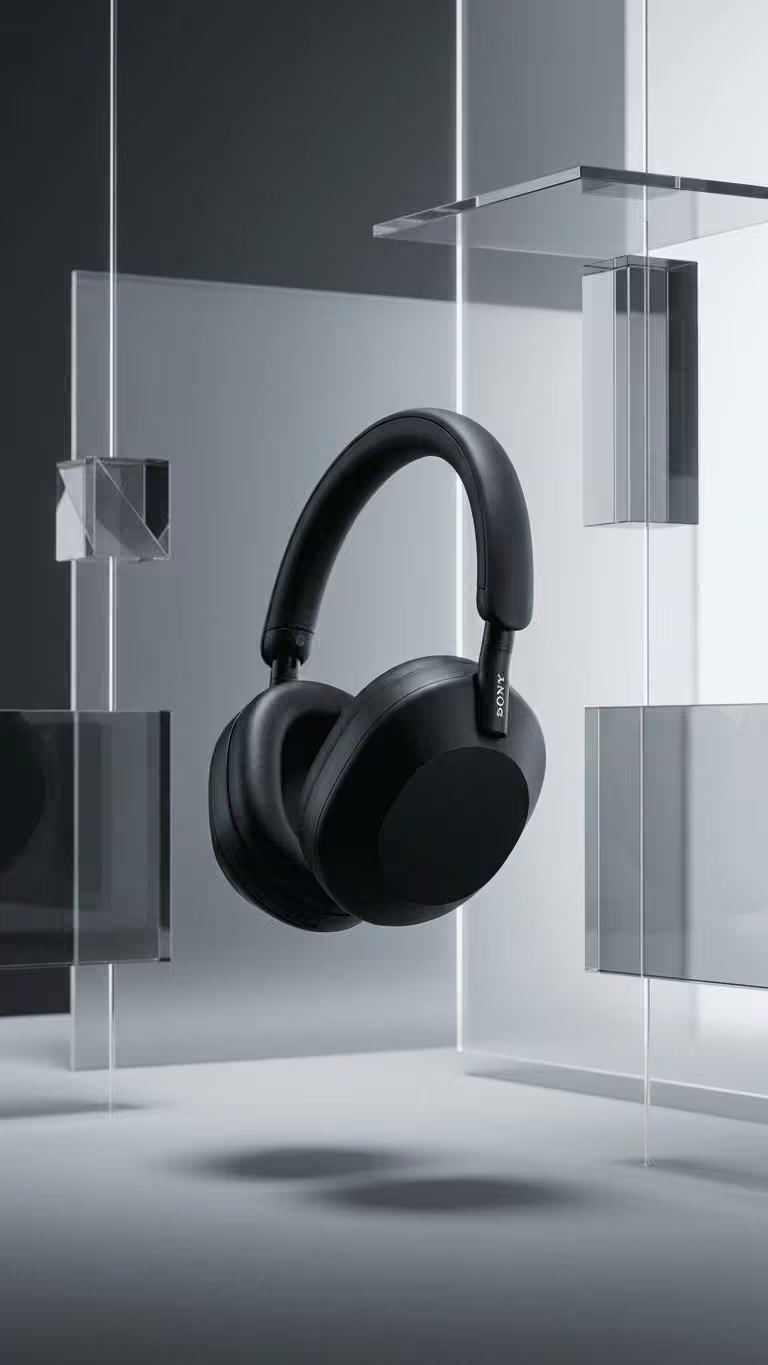
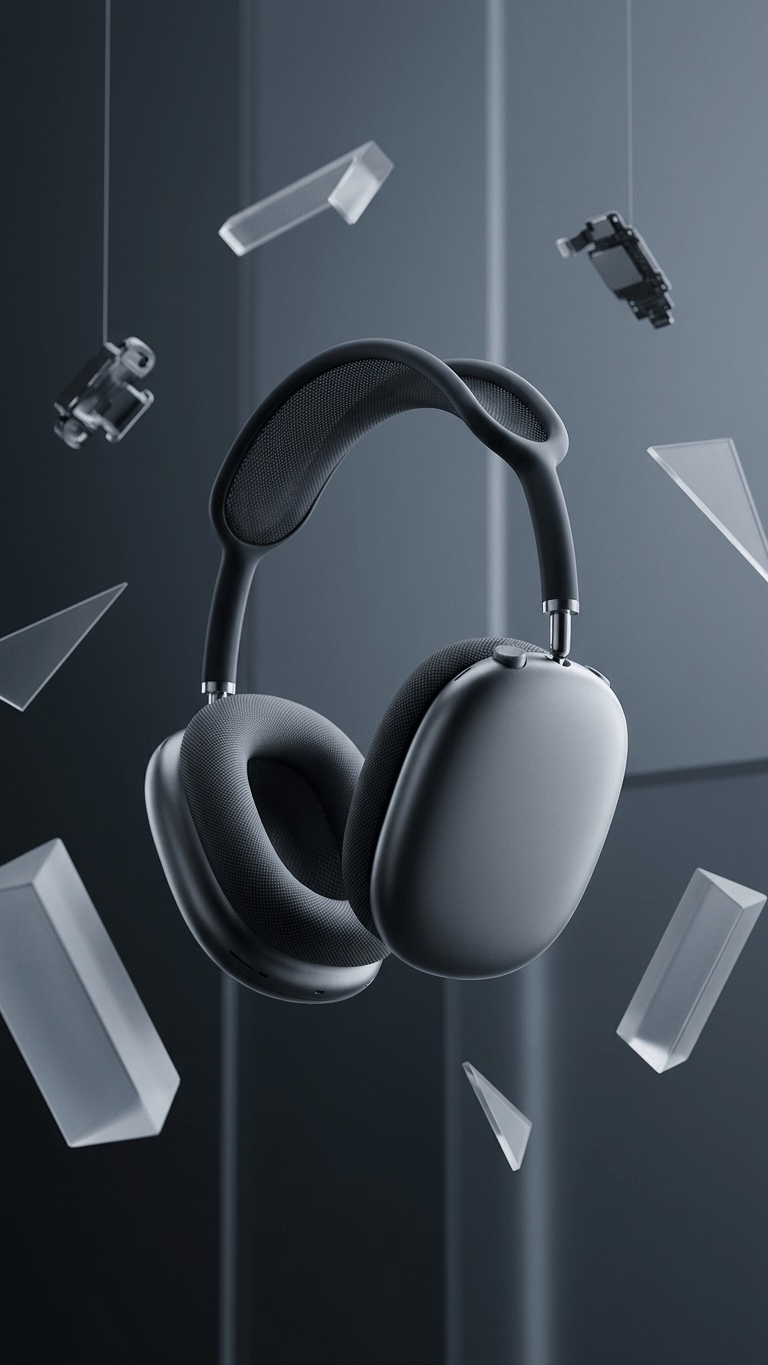
If you want the single best-value, easiest-to-recommend noise-canceling headphone between these two, it's the Sony WH-1000XM5 — it costs less, works equally well on iOS and Android, supports higher-quality Bluetooth codecs, and, according to SoundGuys' lab testing, ships with a longer rated battery life. The Apple AirPods Max earns its price mainly through material quality, a slightly more consistent sound signature according to RTINGS, and deep integration with iPhones, iPads, and Macs.
Commuters and travelers who want the longest battery life, Android users, anyone who wants Hi-Res LDAC audio, and buyers who want to spend less
iPhone/Mac households who value Apple's ecosystem features (Find My, automatic device switching, Spatial Audio with head tracking) and don't mind paying a premium for aluminum-and-steel build quality
Class-leading active noise cancellation, strong microphone performance, and a much lower street price
Premium build materials, excellent Transparency mode, and near-seamless Apple device switching
A widely reported hinge-durability issue (detailed below) and a design that doesn't fold flat
Heavy at roughly 384–386g, no folding mechanism, AAC/SBC-only Bluetooth codec support
Prices for both headphones fluctuate frequently on Amazon and other retailers. Treat every figure below as an approximate range, not a fixed price — always verify the current price before purchasing.
| Headphone | Launch Price | Typical Street Price | Source |
|---|---|---|---|
| Sony WH-1000XM5 | $399–$400 | ~$198–$300 | Kotaku, TechRadar, TechTimes, PCGuide |
| Apple AirPods Max (USB-C) | $549 | ~$380–$450 (new); lower for Renewed | AppleInsider, 9to5Toys, Recording Now |
| Spec | Sony WH-1000XM5 | Apple AirPods Max (USB-C) |
|---|---|---|
| Release date | May 2022 | December 2020 (USB-C: Sept 2024) |
| Weight | ~250–251g | ~384–386g |
| Driver size | 30mm | 40mm |
| Bluetooth version | 5.2 | 5.0 |
| Codec support | SBC, AAC, LDAC | SBC, AAC only |
| Battery (mfr. claim, ANC on) | Up to 30 hours | Up to 20 hours |
| Battery (independently tested) | ~31h 53m (SoundGuys) | ~21h (SoundGuys) |
| Fast charge | 3 min → ~3 hours | 5 min → 1.5 hours |
| Microphones | 8 | 9 total, including beamforming |
| Folding design | No | No |
| Wired audio | 3.5mm aux | USB-C (lossless) |
| Spatial audio | 360 Reality Audio | Spatial Audio + head tracking |
| Multipoint pairing | Yes (all devices) | Yes (Apple devices) |
| Launch price | $399 | $549 |
Note on driver size: Sony's marketing and multiple outlets consistently list a 30mm driver for the WH-1000XM5, a change from the 40mm driver used in the WH-1000XM4. If you see a source citing a different figure, it's likely referencing the earlier XM4 generation — a common source of confusion online.
The core distinction between these two headphones isn't really about which one sounds "better" in isolation — independent testers are fairly close on that question. It's about what kind of listening experience each company optimized for.
Sony built the WH-1000XM5 around noise cancellation and all-day comfort for commuting and travel, backed by a dual-processor ANC system (Sony's QN1 chip paired with the Integrated Processor V1) controlling eight microphones, according to What Hi-Fi's coverage of the original launch. The result, confirmed across independent reviews, is some of the strongest ANC performance available in this headphone class.
Apple built the AirPods Max around tight integration with its own device ecosystem and a distinctive industrial design using aluminum ear cups and a breathable knit mesh headband. Its main selling points aren't raw ANC numbers — RTINGS' comparative testing found the Sony headphones actually edge out the AirPods Max in noise attenuation — but rather build materials, automatic switching between Apple devices, and features like head-tracked Spatial Audio that only work fully within Apple's software.
Active noise cancellation is the single most search-and-purchase-driving feature for both of these headphones, so it deserves its own detailed breakdown.
The WH-1000XM5 uses two processing chips instead of one, driving eight microphones total, with an Auto NC Optimizer that continuously adjusts noise cancellation to your environment without requiring you to manually run a calibration step, according to What Hi-Fi's original launch coverage. Independent measurement from a headphone-testing lab reported roughly 30dB of attenuation in the music-relevant frequency range — a strong, class-leading result.
The AirPods Max uses its H1 chip in each ear cup, paired with a dedicated pressure-sensing microphone inside and outside each ear cup, according to Apple's own technical documentation. SoundGuys' long-term testing found the AirPods Max reduces the loudness of outside noise by an average of about 88% in its labs — a genuinely strong result, and in earlier comparative testing against the Sony WH-1000XM4, SoundGuys found the AirPods Max held up noticeably better at very low frequencies (below roughly 150Hz) than that older Sony model.
Independent testers are close to split, and results can depend heavily on ear shape, glasses, and hair — factors that change how well any headphone seals against your head. RTINGS' broader comparative work found Sony headphones in this class generally edging out the AirPods Max in overall noise attenuation, but the margin in real-world use is often not dramatic. Treat this as a near-tie with a slight edge to Sony, rather than a decisive win for either side.
A caution on ANC claims generally: neither company nor any outlet has published a standardized, apples-to-apples ANC decibel comparison specifically between the WH-1000XM5 and this exact AirPods Max model using identical testing conditions. Treat any single number you see quoted online with some skepticism, and prefer conclusions that multiple sources agree on.
Out of the box, independent reviewers describe a bass-forward but not overwhelming sound signature. SoundGuys' testing found the WH-1000XM5 clearly outperforms headphones like the Bose QuietComfort 45 on both noise attenuation and wireless audio performance, while offering a notably higher available bitrate thanks to LDAC support. GSMArena's review, however, was more critical for critical/audiophile listening, noting that while the sound is "perfectly fine for use outdoors," it found more capable alternatives — including the AirPods Max — for people specifically prioritizing home listening quality. Several reviewers note the stock tuning benefits from EQ adjustment via Sony's Sound Connect app.
RTINGS' testing describes the AirPods Max as delivering more consistent, replicable sound across different people and across repeated reseatings than many rivals — a meaningful trait for a headphone that many people will share, hand off, or readjust throughout the day. GSMArena's comparative commentary placed the AirPods Max among the better-sounding options in this price bracket for focused, critical listening, ahead of the WH-1000XM5 in that specific respect.
The WH-1000XM5 supports Sony's LDAC codec, which permits a substantially higher wireless bitrate on compatible Android phones. The AirPods Max supports only SBC and AAC. On an iPhone, AAC is Apple's preferred codec and performs well; on Android, AAC support and quality vary by phone, according to SoundGuys' codec explainer, and users lose access to any higher-bitrate codec their phone might otherwise support. If you're an Android user who cares about wireless audio quality, this is one of the more concrete, unambiguous advantages the Sony holds.
Sony's 360 Reality Audio format requires supported streaming services and specially mixed tracks to work. Apple's Spatial Audio with dynamic head tracking works more broadly across Apple's own content ecosystem (movies, some Apple Music tracks) and uses the headphones' built-in gyroscopes and accelerometers, according to Apple's product documentation. Neither format is universally supported across all music and video content, so don't expect either feature to transform every song or show you listen to.
The WH-1000XM5 weighs roughly 250–251g and uses a mostly plastic build with soft-fit synthetic leather ear pads. The AirPods Max weighs roughly 384–386g and uses aluminum ear cups, a stainless-steel headband frame, and a breathable knit mesh canopy. That's a substantial weight difference — the AirPods Max is more than 50% heavier — which several reviewers, including SoundGuys, note contributes to fatigue on longer sessions for some wearers, even though the mesh headband is generally well-regarded for distributing that weight.
GSMArena's review found the WH-1000XM5 "not particularly comfortable for extended listening," a sentiment echoed in several owner reviews collected on retailer sites, which describe the thinner ear pads (compared to the previous WH-1000XM4) causing users to readjust the headphones periodically during long sessions. On the Apple side, comfort complaints tend to focus less on the padding and more on sheer weight and — per multiple owner and long-term reviewer reports — the mesh headband trapping heat and, in humid conditions, sometimes showing condensation inside the ear cups.
Neither headphone folds flat. The WH-1000XM5 dropped the folding hinge design used by its WH-1000XM4 predecessor. The AirPods Max has never had a folding mechanism in any generation; its included Smart Case only partially covers the ear cups and doesn't fully protect the headband, a design choice that has drawn criticism since the original 2020 launch.
This is one of the more clear-cut differences between the two headphones.
Sony's official claim is up to 30 hours of playback with ANC enabled. Independent lab testing from a headphone-measurement outlet recorded roughly 31 hours 53 minutes with ANC on and roughly 53 hours with ANC off — meeting or slightly exceeding Sony's own claim. Fast charging delivers about 3 hours of playback from a 3-minute charge, according to Sony's product documentation.
Apple's official claim is up to 20 hours of listening with ANC and Spatial Audio enabled, based on Apple's own internal testing using preproduction units, per Apple's published testing methodology. SoundGuys' independent lab testing found the AirPods Max lasted close to 21 hours with ANC on — essentially matching Apple's claim. A 5-minute charge provides about 1.5 hours of playback.
The gap matters more than it might first appear. A roughly 10-hour difference in rated battery life is significant for frequent travelers.
One nuance: the AirPods Max cannot be fully powered off with a dedicated switch; it enters a low-power state instead, which is worth knowing if you're leaving them unused for an extended period.
SoundGuys describes the WH-1000XM5's call quality as "quite good," powered by an eight-microphone array and Sony's AI-assisted noise-rejection processing. GSMArena's independent testing similarly found that in noisy environments, the noise-reduction algorithm "works really well," with recorded call samples that could pass for having been made in a quiet room, though the reviewer noted vocals could use more upper-frequency detail and fullness compared to premium wired microphones.
Apple's own documentation describes a beamforming microphone array supported by software-based noise reduction. Independent testing from SoundGuys found Apple's microphone results were less consistent across different noise conditions than Sony's equivalent, with the reverberant-space test sample flagged as the weakest result.
Bottom line on calls: across the sources reviewed, Sony's microphone implementation is consistently rated as a strength, arguably its best-reviewed feature alongside ANC. Apple's is described as competent but less consistently praised, particularly in comparative testing against Sony's lineup.
This section reflects patterns identified across retailer reviews (Adorama, Amazon-linked deal threads) and community discussion forums (Slickdeals, Head-Fi). These are recurring themes reported by multiple owners, not laboratory measurements, and individual experiences vary.
Across multiple independent community threads — including several separate Slickdeals deal discussions spanning late 2025 through early 2026, and multiple verified owner reviews on Adorama — a consistent complaint appears: the plastic hinge connecting the ear cup to the headband can crack or separate from normal use, sometimes within months of purchase. Several owners reported that Sony's standard warranty did not cover the failure, or that a warranty replacement failed again after a similar period. One owner review described the ear cup fully detaching from the headband roughly four months after purchase; another reported paying for an extended warranty that did not cover the specific failure.
Given how many independent owners, across multiple unrelated platforms and time periods, describe the same failure point in the same location, YallaBuy classifies the WH-1000XM5 hinge issue as a recurring concern rather than an isolated complaint — though it's worth noting that not every owner experiences it, and some long-term owners in the same threads report no hinge problems at all.
Other recurring owner comments about the WH-1000XM5 include:
Long-term ownership coverage from SoundGuys highlights a few recurring points from owners and their own extended testing:
At full launch price, the AirPods Max's $549 price tag is difficult to justify purely on audio or ANC performance — independent testing doesn't show it decisively outperforming the Sony in those areas, and in several measurements (battery life, ANC attenuation, microphone consistency, codec support) the WH-1000XM5 comes out ahead. The AirPods Max's value case rests almost entirely on build materials and Apple ecosystem integration, which matter a great deal to some buyers and not at all to others.
At current discounted street prices — often $200–$300 for the Sony versus $380–$450 for the Apple — the value gap widens further in Sony's favor for buyers who don't specifically need Apple integration. That said, the hinge-reliability pattern documented above is a legitimate factor to weigh against the WH-1000XM5's lower price; a headphone that needs an out-of-warranty repair isn't actually the bargain it first appears to be.
Check the latest prices on Amazon before they change.
Neither headphone is a bad purchase, and the "better" choice depends heavily on your device ecosystem and priorities rather than a single objective winner.
Choose the Sony WH-1000XM5 if you want the strongest overall value, the longest battery life, broader codec support, and you're comfortable buying with awareness of — and ideally a return-friendly retailer against — the documented hinge-reliability issue.
Choose the Apple AirPods Max if you're firmly inside the Apple ecosystem, you value premium build materials and consistent sound reproduction, and the price difference isn't a primary concern.
This verdict reflects the evidence gathered from the sources cited throughout this article, not a sponsored or affiliate-influenced recommendation — YallaBuy earns the same type of commission regardless of which product you choose to purchase.
Sony official product documentation and What Hi-Fi's WH-1000XM5 launch coverage (whathifi.com)
SoundGuys independent lab reviews: Sony WH-1000XM5, Apple AirPods Max, and head-to-head comparisons (soundguys.com)
RTINGS.com comparative headphone testing (rtings.com)
GSMArena Sony WH-1000XM5 review (gsmarena.com)
Apple official tech specs pages for AirPods Max (USB-C) and Apple Newsroom announcement (apple.com, support.apple.com)
Owner reviews and community discussion: Adorama verified reviews, Slickdeals deal-thread discussions, Head-Fi forum discussion
Deal and pricing coverage: Kotaku, TechRadar, Tom's Guide, TechTimes, PCGuide, 9to5Toys, AppleInsider, Recording Now, Forbes Vetted, 9to5Mac, TechCrunch, Macworld, Macrumors
Prices, availability, and specifications referenced in this article were accurate as of the sources' publication dates in 2026 but can change at any time. Always verify current pricing on Amazon or Apple's official store before making a purchase decision.