Home Tech Guides Deals
Prices change daily on Amazon. The figures shown below are snapshots — always verify the current price before purchasing.
COMPARISON

Sony WH-1000XM5 vs Bose QuietComfort Ultra: Which Noise-Cancelling Headphones Should You Buy?

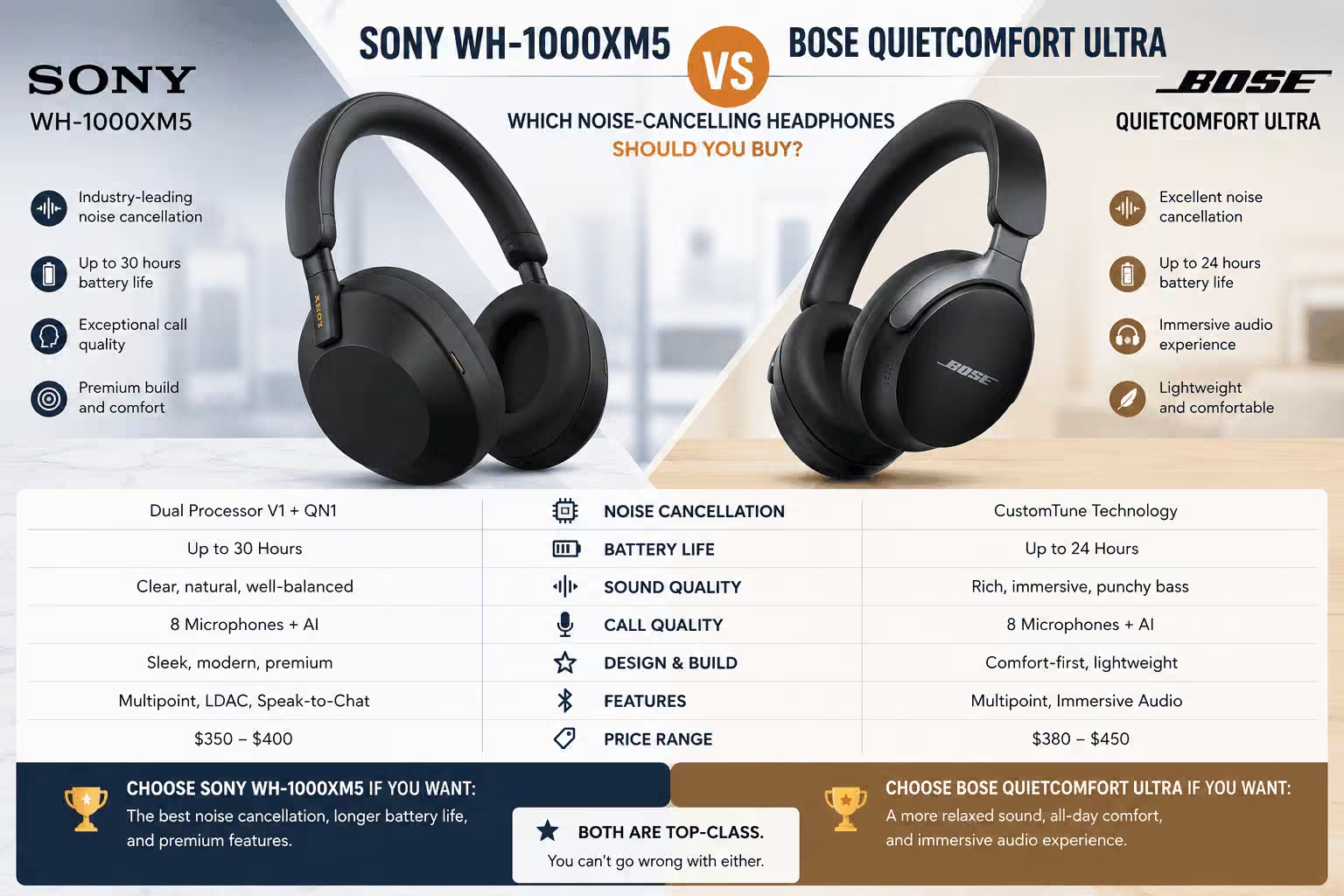
Two of the most talked-about flagship noise-cancelling headphones — now at steep discounts. We break down every category using independent lab data, professional reviews, and real owner reports.

By Mahmoud Hamdy Last updated: August 2026 18 min read
Sony WH-1000XM5 and Bose QuietComfort Ultra side by side

Editorial Disclaimer: YallaBuy has not personally tested these headphones. This comparison is built from official specs, independent lab tests (RTINGS, SoundGuys, Tom's Guide), and verified owner reviews.

At a Glance

The Sony WH-1000XM5 and Bose QuietComfort Ultra Headphones are two of the most talked-about flagship noise-cancelling headphones of the last few years — even though both have technically been succeeded by newer generations. That succession has pushed both into steep, frequent discounts, making this one of the best value match-ups in premium audio right now.

Best for Sound & Battery
Sony WH-1000XM5
Best for Comfort & Build
Bose QC Ultra

According to RTINGS' side-by-side lab comparison, the Bose has a slight edge in comfort and build quality, along with a minor advantage in noise isolation. Meanwhile, SoundGuys and Tom's Guide praised the Sony for its articulate, engaging sound, long 30-hour battery life, and standout call quality.


Current Pricing

Prices change constantly depending on retailer, color, and ongoing promotions. Treat every figure below as a snapshot — always check the current listing on Amazon before buying.

Current Price
Sony WH-1000XM5
$248 $399.99
Save 38%
★★★★★ 4.5 (18,500+ ratings)
Buy on Amazon →

Price tracked at ~$248 in Aug 2026 (Gizmodo, PhoneArena). Low of $198 logged in June 2026 (Pangoly).

Current Price
Bose QuietComfort Ultra
$329 $429
Save 23%
★★★★☆ 4.3 (8,200+ ratings)
Buy on Amazon →

1st Gen price shown. 2nd Gen (~$370–$449) also available — verify which generation before purchasing.


Pros & Cons

Sony WH-1000XM5 Pros

  • Long, class-leading 30-hour battery life with ANC on (per Sony spec)
  • Widely praised sound signature — "articulate and engaging" per Tom's Guide
  • Stellar call quality, called out as a specific strength by Tom's Guide
  • LDAC codec support for high-resolution Bluetooth audio (Android)
  • Can be used passively (wired, powered off) via included cable
  • Currently the more affordable option by a meaningful margin

Sony WH-1000XM5 Cons

  • Recurring, well-documented plastic headband hinge cracking after extended use
  • No official IP water/dust resistance rating
  • Design is now 3+ generations old, superseded by the XM6
  • RTINGS' testing found Bose to have the edge in comfort and build quality

Bose QC Ultra Pros

  • Comfort and build quality rated ahead of Sony by RTINGS' lab testing
  • Effective Immersive Audio spatial sound — "one of the most engaging listening experiences" per Tom's Guide
  • Best-ever ANC for Bose at the time of release (Tom's Guide)
  • aptX Adaptive codec support
  • 2nd Gen adds USB-C wired lossless audio

Bose QC Ultra Cons

  • Higher cost than most rivals, flagged as a specific con by Tom's Guide
  • "Middling battery life" on 1st Gen — 24h ANC, 18h with Immersive Audio
  • Recurring owner reports of strong clamping pressure being uncomfortable
  • Requires power to use wired, unlike the Sony (per RTINGS)
  • Easy to accidentally buy the wrong generation at retail

Key Specifications

Side-by-side specs for the Sony WH-1000XM5, Bose QC Ultra (1st Gen), and Bose QC Ultra (2nd Gen).

Specification Sony WH-1000XM5 Bose QC Ultra (1st Gen) Bose QC Ultra (2nd Gen)
Launch Price$399.99$429$449
Battery (ANC on)30 hours24 hours30 hours
Battery (ANC off)40 hoursNot listed45 hours
Battery (Spatial Audio)N/A18 hours24 hours
Quick Charge3 min ≈ 3 hours15 min ≈ 2.5 hours15 min ≈ 2.5–3 hours
Bluetooth5.25.35.4
Codec SupportSBC, AAC, LDACSBC, AAC, aptX AdaptiveSBC, AAC, aptX Adaptive
Wired ListeningPassive (no power)Requires powerUSB-C lossless
MultipointYesYesYes
Microphones8 total (4 beamforming)Not disclosedNot disclosed
Weight251g~254g250g
Spatial Audio360 Reality AudioImmersive AudioImmersive + Cinema
IP RatingNoneNoneNone
Note on Conflicting Figures

Sony's official specs list 30 hours with ANC on, but one independent lab test (Front Desk Review) measured 31h 53m with ANC on and 53h 6m with ANC off under its own conditions — likely due to different volume levels and codecs. Treat the official 30-hour figure as the conservative real-world planning number.


Both Products Have Newer Successors

Before going further, it's worth being upfront about something a lot of comparison articles skip: neither of these headphones is the current flagship model from its brand anymore.

Sony released the WH-1000XM6 in May 2025 as the direct successor to the XM5, at a launch price of $449.99. According to SoundGuys' testing, the XM6 offers roughly five and a half hours more battery life than the XM5, similar weight at 254g, Bluetooth 5.3 with Auracast compatibility, and a new folding design with detachable earpads.

Bose released the QuietComfort Ultra Headphones (2nd Gen) in October 2025. The 2nd Gen model bumped rated battery life from 24 hours to 30 hours (24 hours with Immersive Audio on, versus 18 hours previously) and added USB-C wired lossless audio support — something the original Ultra Headphones lacked.

Why This Matters

Both the XM5 and the original QC Ultra are now "previous generation" flagships — which is exactly why their prices have fallen so far below MSRP. If your budget stretches to the newer models, they are worth researching separately. But if you're comparing value-for-money flagship ANC headphones today, the XM5-vs-QC-Ultra match-up is arguably a better buy than comparing the current flagships, simply because of how much cheaper both have become.

What Makes Each Product Different?

Sony's core differentiator is its LDAC codec and long-standing reputation for detailed, "fun" sound tuning combined with genuinely class-leading ANC hardware — Sony's official materials describe the WH-1000XM5 as using two processors driving eight microphones for noise cancellation, with an Auto NC Optimizer that adapts to your environment.

Bose's core differentiator is Immersive Audio — its take on spatial/head-tracked audio that works with any content, not just specially mastered tracks — combined with what independent reviewers consistently rate as superior physical comfort and build quality. The 2nd Gen Bose is also the only one of the two to offer genuinely lossless wired audio over USB-C.

Active Noise Cancellation (ANC)

RTINGS' lab comparison found the Bose Ultra Headphones to have a slight edge in noise isolation over the Sony XM5, though the difference is minor and both are well-suited for noisy environments.

This tracks with Sony's own related-product testing: SoundGuys measured the Sony WF-1000XM5 earbuds at roughly 87% average noise attenuation, versus about 83% for the Bose QC Ultra Earbuds — a reminder that ANC performance can vary meaningfully between a brand's earbud and over-ear lines, so headphone-specific test data is the more relevant source here.

Limitations

Neither company publishes a standardized, third-party-verified decibel reduction figure for these exact models. Owner reports also mention situational ANC issues, like popping or crackling around bass and glasses seals.

Sound Quality

Independent measurement site Front Desk Review recorded the Sony WH-1000XM5 with an MDAQS overall score of 4.2 out of 5, with a Timbre score of 4.3 and a Distortion score of 3.6, noting it delivered a tangible benefit over previous WH-1000X models, including notably better low-end performance compared with Bose's Noise Cancelling Headphones 700.

On the Bose side, SoundGuys' comparison of the related earbud lines found the Bose QC Ultra Earbuds (2nd Gen) have a V-shaped signature with boosted bass and treble, while the Sony WF-1000XM5 has more upper-bass emphasis but maintains better clarity in the mids and highs with a wider soundstage — a pattern that broadly echoes what reviewers say about the over-ear models as well.

If you like a boosted, immersive low end, Bose tends to satisfy that preference; if you want more clarity and detail retrieval, reviewers more often point to Sony. Both companies offer in-app EQ adjustment, so out-of-the-box tuning differences can be reduced somewhat by users willing to tweak settings.

Battery Life

According to official specifications, the Sony WH-1000XM5 is rated for 30 hours with ANC on and 40 hours with ANC off. The original Bose QC Ultra is rated for 24 hours with ANC on, dropping to 18 hours with Immersive Audio engaged — a gap Tom's Guide specifically called out as "middling battery life for a flagship design."

The 2nd Gen Bose closes that gap significantly, with What Hi-Fi? reporting 30 hours with ANC on, 45 hours with ANC off — more or less matching the Sony XM6 — though Immersive Audio still drops the 2nd Gen's runtime to around 23 hours.

Real-world battery life depends heavily on volume level, codec choice (LDAC and aptX Adaptive both draw more power than SBC/AAC), and how often ANC or spatial audio modes are toggled.

Call Quality and Microphones

Sony's official materials describe the WH-1000XM5's call system as using Precise Voice Pickup Technology and four beamforming microphones working together to ensure clear voice capture, even in noisy environments. Tom's Guide specifically listed "stellar call quality" as a pro for the Sony.

Transparency Note

We were not able to independently verify a directly comparable, methodology-matched call-quality test score for the Bose QC Ultra from the sources gathered. If call quality is a priority, we recommend checking a recent side-by-side mic-sample video or RTINGS' dedicated microphone testing for both models.

Comfort and Build Quality

This is one of the clearest, most consistently sourced differences in this comparison. RTINGS' direct lab comparison concluded the Bose QC Ultra Headphones are more comfortable and better built than the Sony WH-1000XM5.

However, comfort is highly individual — head size, glasses use, and ear shape all affect how any headphone clamps and seals. Some Bose owners report the opposite experience (over-clamping discomfort), covered in the Problems section below.

Codec and Wired Support

The Sony supports the LDAC codec (useful for high-resolution streaming on compatible Android devices) and can be used passively when wired — the cable works even with the headphones powered off. The Bose supports aptX Adaptive and requires the headphones to be powered on to use the wired connection.

The 2nd Gen Bose adds a meaningful upgrade: USB-C wired lossless CD-quality audio, something not possible over Bluetooth even with aptX Adaptive.


What Reviewers Found

Source Verdict
RTINGS Gave the overall edge to Bose, citing better comfort, better build quality, and slight noise isolation advantage. Noted Sony's LDAC and passive wired as points in its favor.
Tom's Guide Sony excels in sound, control options, noise cancellation, battery life, and call quality. Bose strengths: design, Immersive Audio, intuitive controls, and ANC. Weak points: cost and battery life.
SoundGuys Related earbud testing found Sony edged out Bose on raw noise attenuation by ~4 percentage points (87% vs 83%) — directionally informative for the over-ear line.
Where Sources Agree

Both headphones deliver genuinely strong, flagship-tier ANC and sound quality — none of the independent testers described either product as a weak performer overall.


What Owners Report

Based on patterns identified across verified purchase reviews on Amazon, Adorama, and Slickdeals — not on YallaBuy's own testing.

Sony WH-1000XM5: A Recurring Hinge/Headband Complaint

Across several independent review threads, a specific, repeated complaint emerges: the plastic hinge connecting the headband to the ear cup cracking or breaking after roughly one to two years of normal use.

One Adorama reviewer described the joint breaking about a year in, describing it as a common issue after researching further, and needing an out-of-warranty $150 repair through Sony's service partner. Another reviewer independently reported the same "notorious hinge issue" after a warranty replacement unit also failed the same way. In a Slickdeals discussion thread, a commenter linked to a Reddit community poll and described the hinge breaking after two years of daily use, while another flagged the hinges as "very prone to breaking/cracking from normal use," citing two active warranty claims of their own.

Our Assessment

Given that this issue was independently reported across multiple separate sources — Adorama customer reviews, a Slickdeals community thread, and a referenced Reddit discussion — we classify this as a recurring concern rather than an isolated complaint. That said, YallaBuy has not seen official failure-rate data from Sony, so we can't quantify what percentage of units are affected.

Other, less frequently repeated owner complaints include occasional Bluetooth reconnection drops during movement and headband comfort/padding complaints after roughly 30 minutes of continuous wear — these appear with less frequency and should be read as individual reports.

Bose QC Ultra: Clamping Pressure and Connectivity Reports

The most consistently repeated comfort complaint about the original QC Ultra in owner reviews is clamping pressure. One detailed Adorama review described the headphones as otherwise excellent but noted the clamping pressure being significantly stronger than the standard QuietComfort line, to the point the reviewer couldn't wear them comfortably for long sessions.

For the 2nd Gen Bose, we found at least one detailed owner report of a specific connectivity problem: Bluetooth stuttering specifically when using Bose's USB dongle with a PC, described as a commonly reported issue with the Gen 2 specifically. We classify this as an individual report rather than a confirmed widespread pattern — but it's worth checking recent reviews if you plan to use the headphones primarily via USB dongle.

Some 2nd Gen owners also reported the on-head wear sensor occasionally misfiring and pausing audio unexpectedly — a minor but recurring annoyance rather than a major flaw.


Problems & Limitations Summary

Issue Sony WH-1000XM5 Bose QC Ultra
Most-repeated owner complaint Hinge/headband joint cracking after 1–2 years (recurring pattern, multiple independent sources) Strong clamping pressure uncomfortable for some (1st Gen); occasional USB dongle Bluetooth stutter (2nd Gen, isolated report)
Official IP rating None None
Warranty gaps reported Hinge damage sometimes ruled outside standard warranty per owner accounts Not specifically reported in our source set
Independent comfort/build verdict Rated behind Bose by RTINGS Rated ahead of Sony by RTINGS

Neither manufacturer publishes official failure-rate statistics, so treat both of these as patterns worth being aware of — not confirmed defect rates.


Comparison at a Glance

Category Winner
Price todaySony WH-1000XM5 (consistently cheaper)
Battery life (vs. 1st Gen QC Ultra)Sony WH-1000XM5 (30h vs 24h ANC-on)
Battery life (vs. 2nd Gen QC Ultra)Roughly tied — both rated at 30h ANC-on
Comfort and build qualityBose QC Ultra, per RTINGS
Noise isolationBose, by a slim margin, per RTINGS
Call qualitySony, per Tom's Guide
Spatial/immersive audioBose (Immersive Audio more developed)
Wired listening flexibilitySony (passive, no power) vs 1st Gen; Bose 2nd Gen (lossless USB-C) vs 2nd Gen
Codec supportDepends on device — Sony favors Android/LDAC, Bose favors aptX Adaptive

Who Should Buy What?

Buy the Sony WH-1000XM5 if…

  • You want the longest battery life for the money
  • You're an Android user who wants LDAC support
  • You want passive wired listening (no battery required)
  • You prioritize call quality on the go
  • You're budget-conscious — XM5 is reliably cheaper
Check Price on Amazon →

Buy the Bose QC Ultra if…

  • You prioritize comfort and build quality above all else
  • You want Immersive Audio that works with regular stereo content
  • You're considering the 2nd Gen for USB-C lossless audio
  • You don't mind paying a premium for class-leading ANC
Check Price on Amazon →

Consider neither if…

  • Your budget allows for the current flagships (XM6 or QC Ultra 2nd Gen) — they bring meaningful upgrades worth researching separately
  • You've had hinge-related durability issues with a previous Sony WH-1000X model — try both on in person first
  • You know you have a head shape that finds strong clamping pressure uncomfortable — a documented Bose QC Ultra complaint
  • Wired, powered-off passive listening is a hard requirement (e.g., aircraft entertainment systems) — the Sony's passive cable support is a specific advantage here

Value for Money

At current discounted prices, this comparison tilts meaningfully toward the Sony WH-1000XM5 on pure dollars-per-feature. Multiple retail and deal-tracking sources placed the XM5 as low as roughly $198–$250 in mid-2026, while the original QC Ultra has more commonly been tracked in the $280–$380 range and the 2nd Gen model nearer to its $449 MSRP, with occasional dips toward $370.

That said, "value" depends on what you're optimizing for. If comfort during multi-hour daily wear is your top priority, RTINGS' independent testing suggests the Bose is worth the price gap for many buyers. If you mainly want strong ANC, long battery life, and flexible codec support at the lowest possible price, the current Sony pricing is difficult to beat.

⚠ Always Verify

Deals on both products, especially the Sony, have moved by over $100 within a matter of weeks based on the retail activity tracked in this research. Always verify current pricing before buying.


The Bottom Line

Both headphones remain genuinely strong choices in 2026, which is exactly why review outlets keep publishing fresh comparisons of them years after launch.

Choose the Sony WH-1000XM5 if price, battery life, and flexible wired/codec support matter most — and you're comfortable with the well-documented hinge durability concern. Consider a protective case if you travel often.
Choose the Bose QC Ultra if comfort, build quality, and an immersive spatial audio experience matter more than saving money — just double-check whether you're buying the 1st or 2nd Gen, and be aware of the clamping-pressure complaints.

Neither is an objectively "better" headphone in every category — the evidence points to a genuine trade-off between price/battery life and comfort/build quality. Check current pricing on Amazon for both before deciding, since the price gap fluctuates constantly.

Sony XM5 on Amazon → Bose QC Ultra on Amazon →

Frequently Asked Questions

Per RTINGS' direct lab comparison, the Bose has a slight edge in noise isolation, though the difference was described as minor, with both headphones well-suited for noisy environments.
Against the original QuietComfort Ultra Headphones, the Sony wins clearly on official specs (30 hours vs. 24 hours with ANC on). Against the 2nd Gen QC Ultra Headphones, both are rated at 30 hours with ANC on, per official specifications from each brand.
Independent outlets including SoundGuys continue to describe it as an excellent choice for anyone who doesn't need the absolute latest features, particularly given how far its price has dropped since the WH-1000XM6 launched.
Multiple independent owner reviews and community discussions describe a recurring hinge/headband joint issue after roughly one to two years of use. This is a recurring pattern across several independent sources, not an isolated complaint, though we found no official failure-rate data from Sony to quantify how common it is.
At least one detailed independent owner review described the clamping pressure of the original QuietComfort Ultra Headphones as uncomfortably strong compared to Bose's standard QuietComfort line. This appears to be an individual sensitivity rather than a universal complaint, but it's worth trying the headphones on in person if possible.
According to Bose and independent reviews from What Hi-Fi? and Android Central, the 2nd Gen model increased battery life from 24 to 30 hours with ANC on, added USB-C wired lossless audio support, upgraded Bluetooth from 5.3 to 5.4, and added a new Cinema mode for the Immersive Audio feature — all while Bose kept the price unchanged.
Tom's Guide specifically listed "stellar call quality" as a strength of the Sony WH-1000XM5 in its head-to-head review. We did not find a directly comparable, methodology-matched independent call-quality score for the Bose QuietComfort Ultra Headphones in the sources gathered for this article, so we can't make a confident direct comparison here — check a recent side-by-side microphone test if call quality is a deciding factor for you.

Sources & Further Reading

MH
About the Author
Mahmoud Hamdy
Founder & Editor at YallaBuy