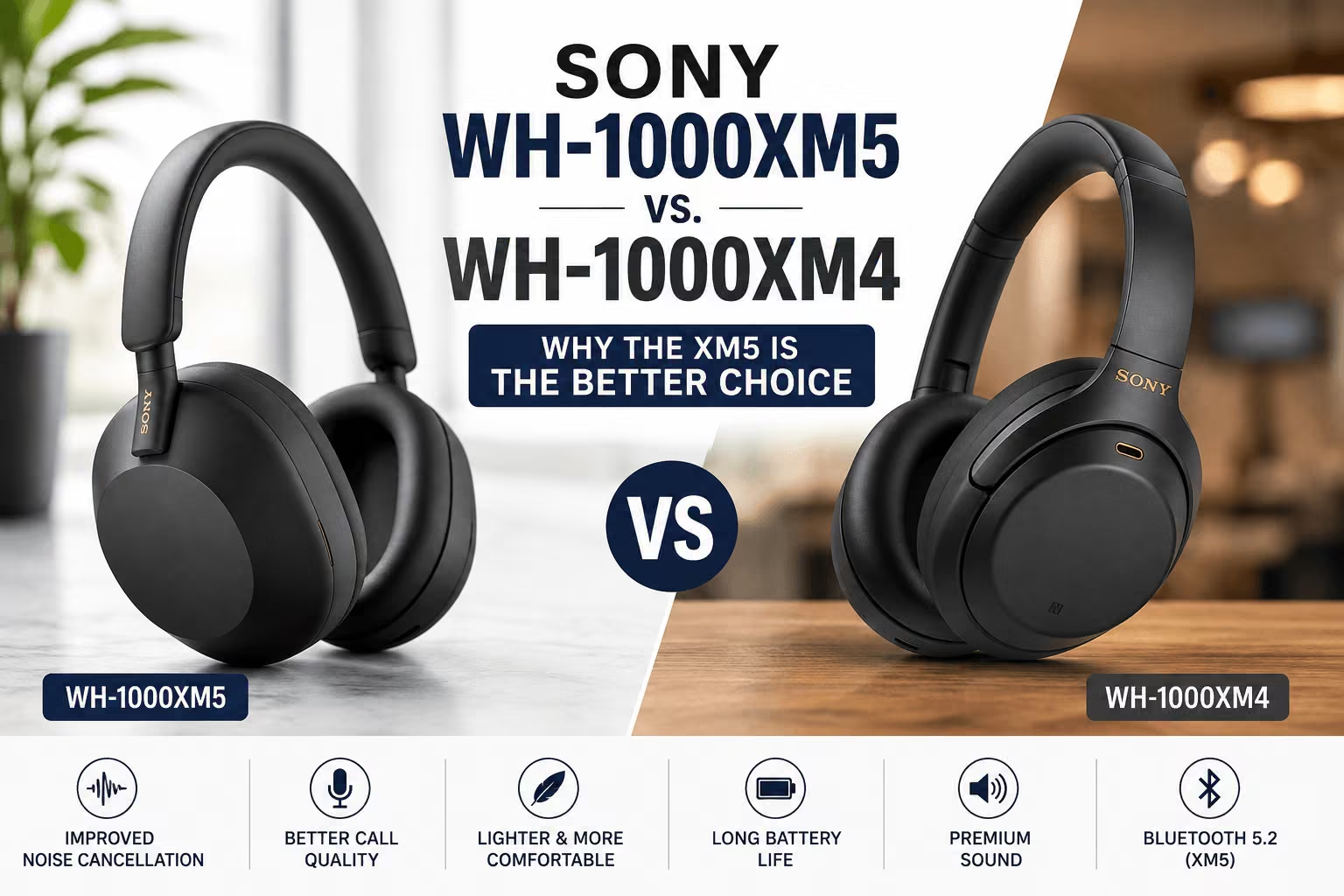
Why the Sony WH-1000XM5 Is the Better Choice Over the WH-1000XM4
Based on the weight of independent testing, the WH-1000XM5 wins on the two things that matter most in daily use: noise cancellation and call quality. Here's the full evidence.
Editorial Transparency: YallaBuy has not personally tested the Sony WH-1000XM5 or WH-1000XM4. This recommendation is based on official Sony specifications and independent testing from publications including RTINGS, SoundGuys, What Hi-Fi?, TechRadar, Tom's Guide, and Reviewed, plus recurring patterns found in owner feedback on Amazon, Reddit, and Slickdeals. Every claim below is attributed to its source, and we've been honest about where the XM4 still holds up.
Affiliate Disclosure: YallaBuy may earn a commission if you purchase through links on this page. This does not affect our recommendations.
Price Notice: Prices for both headphones fluctuate frequently on Amazon and may change at any time without notice. The prices mentioned in this article reflect ranges reported at the time of writing and should not be treated as current or guaranteed. Always verify the actual price on Amazon before making a purchase.
Quick Verdict
The WH-1000XM5 is the better overall choice for most buyers — winning on ANC and call quality — but the XM4 still has a real case for portability, warmer sound, and lower price.
Why XM5 Wins
Stronger, more consistent ANC
Noticeably better call quality
Adaptive ANC with no manual steps
Faster quick charging
Where XM4 Competes
Foldable, more portable design
Warmer out-of-box sound tuning
Often available at lower price
No reported hinge durability issues
Price & Availability
Prices for both headphones fluctuate significantly and should always be verified before purchase — treat the numbers below as a general range, not a live quote.
The WH-1000XM5 launched at a $399 list price, but sale prices reported by outlets such as Gizmodo, Consequence, and Slickdeals have repeatedly pushed it down to the $198–$280 range during promotional periods like Prime Day, Memorial Day, and Black Friday. According to camelcamelcamel's Amazon price-tracking history, the price moves throughout the year, so a "deal" price is never guaranteed to last.
The WH-1000XM4 situation is more complicated. Sony has been winding down new production in favor of the XM5 and XM6, and PC Guide reports that new-condition XM4 stock on Amazon has become scarce, with many current listings being used or third-party units starting around $155–$330. Leaks reported by 9to5Google and PC Guide also point to a possible XM4C refresh around $250 launching later in 2026 with a slightly shorter battery life — worth watching if you specifically want the XM4's folding design at a lower price than the XM5.
So what? Even accounting for the XM5 usually costing somewhat more, the price gap during sales is often small enough — sometimes $30–$50 — that the XM5's advantages in ANC and calls are worth paying for. If you find the XM4 at a steep discount and don't need those specific strengths, it remains a reasonable alternative.
1
Noise Cancellation Is More Consistently Effective
This is the clearest evidence-backed reason to favor the XM5. SoundGuys' side-by-side testing found the XM5's ANC and wind-noise cancellation outperformed the XM4, and What Hi-Fi's testing described the XM5 as having "some of the best overall attenuation around." The XM5 also uses 8 microphones across two processors versus the XM4's 5–6, and adds 11 adaptive ANC presets compared to the XM4's 4 manual settings.
To be fair, this advantage isn't universal. RecordingNow's hands-on comparison noted that in some environments, the XM4's noise cancellation felt slightly more effective, possibly because of its dedicated NC Optimizer feature. TechRadar's review similarly concluded both models "scored full marks," suggesting the gap matters more in specific conditions — windy outdoor use, loud transit — than in quiet indoor listening.
It's also worth noting how these two headphones approach ANC differently, not just how well each performs. The XM4 relies on a single, user-triggered "NC Optimizer" that recalibrates once you press a button, tailoring cancellation to your ear shape, hairstyle, and current environment at that moment. The XM5 instead runs continuous, automatic adjustment via Sony's Adaptive Sound Control, using onboard sensors to detect activity and location changes without any manual step. Independent reviewers generally view the automated approach as more convenient for people who move between settings throughout the day.
So what? If you use your headphones outdoors, while commuting, or in variable environments, the XM5's more adaptive and consistent ANC system is the more reliable choice. If you mostly listen in one quiet space, this reason carries less weight.
2
Call Quality Is a Genuine Step Up
What Hi-Fi's testing ranked the XM5 as having the best call quality in the entire WH-1000X family, crediting Sony's four-beamforming-mic Precise Voice Pickup system with AI-based noise reduction and wind-noise suppression. This is one of the few areas where independent reviewers are largely aligned rather than split.
This gap comes down to hardware. The XM5's four beamforming microphones work alongside AI-based voice separation to isolate your speech from background noise before it reaches the person on the other end of the call. The XM4's older microphone array can still produce clear calls in quiet settings, but reviewers note it struggles more noticeably once wind, traffic, or crowd noise enters the picture — exactly the situations where a dedicated business or commuter headphone earns its keep.
So what? If you take calls or join video meetings from noisy environments — open offices, cafés, outdoors — this is arguably the single most practical, real-world reason to pick the XM5 over the XM4.
3
Sound Quality Has a Higher Ceiling (With a Caveat)
What Hi-Fi's testing described the XM5 as sounding "clearer and more open" than the XM4, with more precise low-end detail. However, more than one independent reviewer flags an important caveat: the XM5's stock tuning is less immediately pleasing out of the box. RecordingNow specifically said it preferred the older XM4's default sound and found the XM5 only pulled ahead after EQ adjustment through Sony's app.
So what? This is a qualified reason to choose the XM5 — it rewards listeners willing to spend a few minutes in the Sony | Headphones Connect app adjusting EQ. If you want a headphone that sounds great the moment you unbox it with no tinkering, this particular reason favors the XM4 instead, which is why we don't treat it as a decisive factor on its own.
4
Faster Charging, Comparable Battery Life
Sony rates both headphones at 30 hours with ANC on — officially identical. With ANC off, the XM5's rated maximum is modestly higher (up to 40 hours vs. up to 38 for the XM4), a two-hour improvement per What Hi-Fi's reporting. The more consistent real-world advantage is charging speed: the XM5's quick charge delivers roughly 3 hours of playback from a 3-minute charge, versus the XM4's 5 hours from a 10-minute charge — a better rate per minute of charging time, useful if you're frequently topping up on short breaks.
Independent real-world battery figures vary across publications and testing conditions (volume level, codec, ANC setting), so exact numbers beyond Sony's official ratings should be treated as directional rather than precise.
So what? Don't expect a dramatic battery upgrade from XM4 to XM5 — this is a minor, supporting reason rather than a primary one.
5
A More Adaptive, Less Manual Software Experience
Both headphones pair with the Sony | Headphones Connect app for firmware, EQ, and ANC customization. The XM4 requires manually triggering its NC Optimizer feature each time you want the headphones to recalibrate to a new environment. The XM5 automates this as part of its broader Adaptive Sound Control system, adjusting noise cancellation based on detected activity and location without manual input.
So what? If you move between environments often — home, office, transit — the XM5 removes a manual step. If you use your headphones in one consistent setting, this difference won't be noticeable day to day.
Where the XM4 Still Holds Its Ground
A fair recommendation has to acknowledge where the older model wins, and there are two areas worth taking seriously.
XM4 Advantages
Portability: The XM4 folds and twists into a compact shape. What Hi-Fi and SoundGuys both note this makes it meaningfully easier to pack for travel.
Build reputation: The XM4 uses a bulkier but more traditional yoke-and-hinge system historically described as sturdy.
Out-of-box sound: More than one reviewer found the XM4's default tuning more immediately enjoyable, with warmer bass and a fuller low end.
XM4 Limitations
Call quality is clearly behind the XM5 in noisy environments according to multiple reviewers.
ANC requires manual NC Optimizer triggering rather than continuous automatic adaptation.
New retail stock is becoming scarce as Sony shifts production to newer models.
Neither of these is enough, on the weight of the evidence, to override the ANC and call-quality advantages for most buyers — but they matter enough that frequent travelers or price-focused buyers should weigh them seriously before assuming the XM5 is automatically right for them.
The Hinge Issue: Why We're Not Ignoring It
This section is based on customer feedback, not laboratory testing, and should be read as a reported pattern rather than a statistically confirmed failure rate — but it's significant enough that any honest recommendation of the XM5 has to address it directly.
Notebookcheck reported that the WH-1000XM5 "already struggled with widespread hinge defects," a description it used when covering a similar early issue on the newer XM6.
Multiple Amazon customer reviews collected via Adorama describe hinges cracking or separating from the ear cup after months of normal use, with some reviewers stating their warranty claims were denied because the headband wasn't covered.
On Slickdeals forum threads, multiple users independently describe the hinge as "the Achilles heel" of the XM5, with some reporting failures recurring even after a warranty replacement.
Because this pattern appears consistently across a specialist tech outlet, retailer review sections, and independent forums, YallaBuy treats it as a legitimate, recurring durability concern — not proof that most units fail, since the proportion of affected headphones among all XM5 owners can't be determined from public reports alone, but a real risk worth factoring into your decision or your warranty choice. The WH-1000XM4 does not show the same volume or consistency of hinge-specific complaints in available sources.
Despite this, we still consider the XM5 the better overall choice, because the ANC and call-quality advantages are consistent enough — and the hinge issue, while real, doesn't appear to affect every unit. If durability is your top priority, the newer WH-1000XM6 is worth researching separately; Notebookcheck reports Sony added more metal to its hinge construction, though it also noted an early hinge failure report on the XM6 itself.
Key Specifications
Spec
WH-1000XM5
WH-1000XM4
Launch Price
$399
$349
Microphones
8 (2 processors)
5–6
Battery (ANC On)
30 hours*
30 hours*
Battery (ANC Off)
Up to 40 hours*
Up to 38 hours*
Quick Charge
~3 hrs / 3 min
~5 hrs / 10 min
Foldable Design
No (flattens only)
Yes (folds & twists)
Driver Size
30mm
40mm
ANC Presets
11 adaptive settings
4 settings + NC Optimizer
* Sony's battery figures are manufacturer claims, not independent lab measurements — treat any single third-party number you encounter elsewhere with some caution and prefer ranges over precise decimals.
At full list price, the XM5's roughly $50 premium over the XM4's original price is a reasonable trade for meaningfully better call quality and ANC, based on the independent testing summarized above. Because both headphones are discounted frequently — and because new XM4 stock is drying up — the actual value calculation depends on what each is selling for on the day you're shopping. When the price gap between a discounted XM4 and a discounted XM5 is small, the XM5's strengths are worth paying for. When the XM4 is available new or in excellent used condition for significantly less, it remains a defensible choice for buyers who don't need the XM5's specific advantages.
Check Current Prices on Amazon
Prices change frequently. Click below to verify the latest price before purchasing.
The evidence supports the WH-1000XM5 as the better choice over the WH-1000XM4 for most buyers, primarily because of its stronger and more consistent noise cancellation and a clear step up in call quality — the two areas independent reviewers agree on most. It is not a decisive win in every category: battery life is essentially unchanged from Sony's own ratings, sound quality needs EQ work to pull ahead according to more than one reviewer, and the recurring hinge-durability reports are a real factor, not a footnote.
If your priorities are call quality, adaptive ANC, and comfort for larger heads, and you can catch the XM5 on sale, it's the stronger recommendation. If you specifically want a foldable design, a warmer out-of-box sound, or the lowest price on a well-reviewed pair of flagship-class headphones, the XM4 remains a legitimate alternative — just be prepared to shop used or open-box listings as new stock becomes harder to find.
Frequently Asked Questions
Independent testing points to two consistent advantages: stronger and more adaptive noise cancellation, and clearly better call quality thanks to its 8-microphone array. These are the two reasons carrying the most weight in this recommendation.
Multiple independent sources — including a specialist tech outlet and numerous Amazon and forum reviews — describe recurring hinge or headband failures. This appears to be a genuine, recurring pattern based on available evidence, though the exact failure rate among all units sold can't be confirmed from public reports.
It can still be a good value, particularly if you find a well-reviewed unit at a meaningfully lower price than the XM5. However, new retail stock has become harder to find as Sony shifts production toward the XM5 and XM6.
Sony rates both at 30 hours with ANC enabled — officially identical. With ANC off, the XM5's rated maximum is modestly higher (up to 40 hours vs. up to 38). Independent real-world figures vary by source and testing method.
If your budget allows for a higher price, the XM6 is Sony's current flagship and reportedly uses a revised hinge construction. It's worth researching separately if durability is your top concern.
Sources & Further Reading
What Hi-Fi? — Sony WH-1000XM5 vs WH-1000XM4 comparison
SoundGuys — Sony WH-1000XM4 vs Sony WH-1000XM5
RTINGS.com — Sony WH-1000XM4 vs WH-1000XM5 comparison tool
TechRadar — "The Sony WH-1000XM5 headphones are great, but the XM4 are the better buy"
Tom's Guide — Sony WH-1000XM5 vs. WH-1000XM4 face-off
Reviewed — Sony WH-1000XM4 vs WH-1000XM5: Which is best for you?
Notebookcheck — Sony WH-1000XM6 hinge defect reporting (referencing prior XM5 pattern)
PC Guide — Reporting on WH-1000XM4 retail availability and rumored WH-1000XM4C
Amazon customer reviews (via Adorama listings) and Slickdeals community forum threads — owner feedback on hinge durability
Prices and availability referenced in this article change frequently. Always verify current pricing before purchasing.