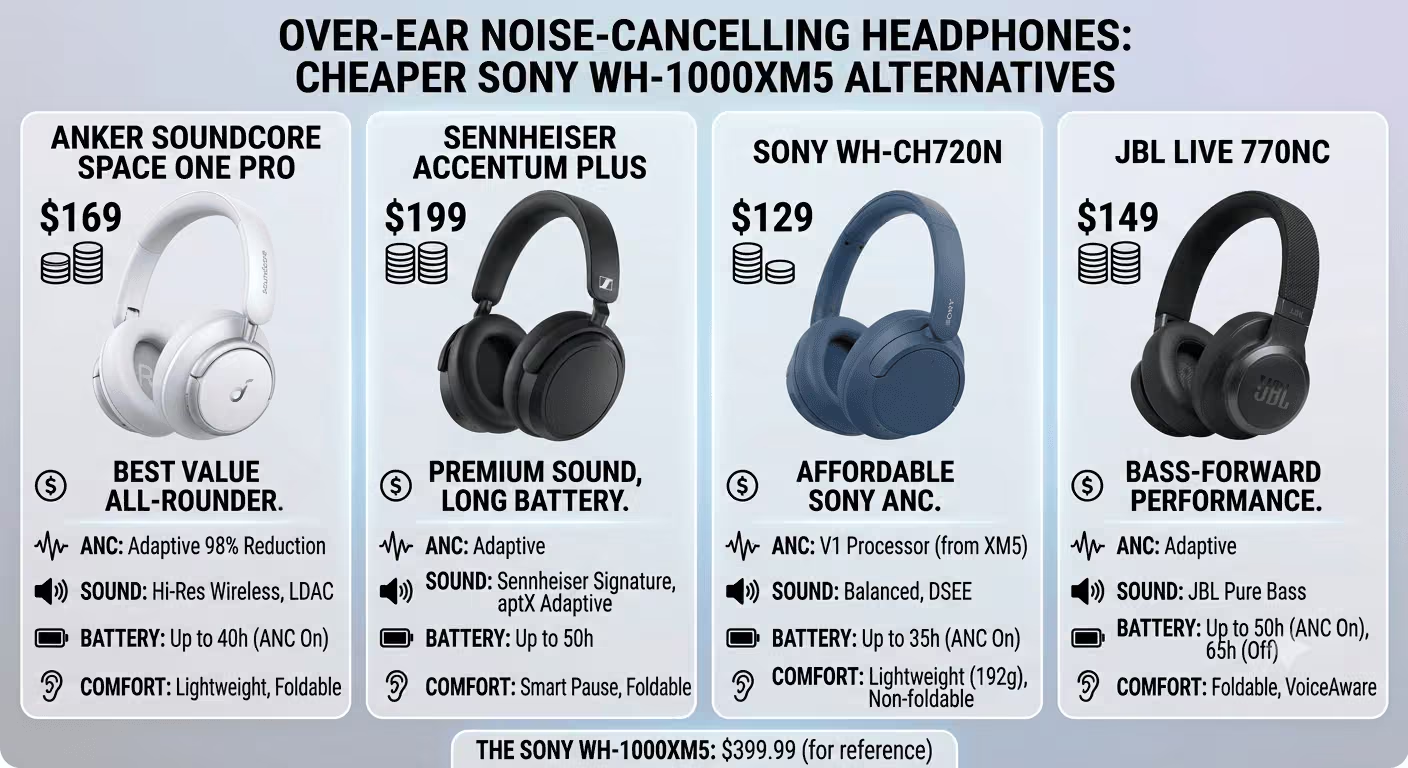
Why Look Beyond the Sony WH-1000XM5?
The Sony WH-1000XM5 earned its reputation as one of the most complete noise-cancelling headphones on the market: strong active noise cancellation (ANC), a comfortable fit, and reliable call quality. But it carries a flagship price, and it's no longer Sony's newest model — the WH-1000XM6 has since taken over as the current flagship, which has pushed WH-1000XM5 pricing down and created room for a wave of genuinely competent, much cheaper alternatives.
If you're searching for cheaper alternatives to the WH-1000XM5, you're probably trying to answer one of a few questions: Can I get 80–90% of the experience for half the price or less? Which budget or mid-range ANC headphones have independent testing behind their claims? Is it smarter to buy an older or lower-tier Sony instead of switching brands? And what specific trade-offs — comfort, call quality, codecs — come with going cheaper?
It's also worth being upfront about what this guide is not. It's not a claim that any of these seven alternatives beats the WH-1000XM5 outright — independent testing generally still favors Sony's flagship on overall polish and consistency. What it does answer is a narrower, more useful question: if you specifically like what the WH-1000XM5 represents but don't want to pay flagship pricing, which alternatives have real evidence behind them, and what do you give up with each one?
Quick Verdict: The Short Answer
- Best overall value: Sony WH-CH720N — Sony's own sound tuning and ANC processor at roughly a quarter of the WH-1000XM5's original price.
- Closest to the WH-1000XM5 experience: Sony WH-1000XM4 — the direct predecessor, still sold new and frequently discounted.
- Best noise cancellation per dollar: Anker Soundcore Space One — unusually strong ANC for a sub-$120 headphone.
- Best sound quality for the price: Sennheiser Accentum Wireless — reviewers consistently single out its tuning.
- Best feature set and customization: JBL Tour One M2 — extensive EQ, hearing personalization, and adaptive ANC.
- Best known premium brand at a mid-range price: Bose QuietComfort Headphones (2023).
- Best true budget pick: 1MORE SonoFlow / SonoFlow SE — often under $60, with independent testers repeatedly flagging it as outperforming its price class.
None of these headphones beats the Sony WH-1000XM5 in every category. Each one wins for a specific kind of buyer — which is why this guide is broken down by trade-off rather than a single universal winner.
Key Terms Worth Understanding Before You Compare
ANC vs. passive isolation
Passive isolation is the physical blocking of sound by the ear cup material and seal. Active noise cancellation uses microphones to detect incoming sound and generates an inverse wave to cancel it electronically. ANC is far more effective against low, steady noise (engine hum, HVAC) than against sudden or high-pitched sound (voices, clattering dishes). This is why the Sennheiser Accentum Wireless scores well against mid-and-high-frequency noise while lagging specifically in the low-frequency range that matters most on airplanes.
Bluetooth codecs (SBC, AAC, LDAC, aptX)
A codec determines how audio is compressed for wireless transmission. SBC is the baseline every headphone supports but the lowest quality. AAC works well specifically with Apple devices. LDAC (Sony) and aptX/aptX Adaptive (Qualcomm) allow higher-resolution streaming — but only if your source device supports the same codec. An iPhone cannot use LDAC even if the headphones support it. Before paying more for codec support, confirm your phone or laptop actually supports the matching codec.
Bluetooth multipoint and latency
Multipoint lets a headphone stay connected to two devices simultaneously and switch audio between them without re-pairing — increasingly common even in budget headphones on this list. Latency is the delay between audio being sent and heard; above roughly 150–200ms it becomes noticeable as out-of-sync video. This is why the Sony WH-CH720N's measured ~290ms latency and the Bose QuietComfort's ~183ms lag are called out specifically — they matter far more to video-callers and gamers than to music listeners.
Comparison Table: WH-1000XM5 vs. Seven Alternatives
| Headphone | Price Range* | ANC (Independent Testing) | Battery (Rated / Measured) | Codecs | Weight | Best For |
|---|---|---|---|---|---|---|
| Sony WH-1000XM5 (reference) | $280–$400 | Class-leading; RTINGS rates isolation near the top of the category | 30 hrs rated; ~32 hrs 53 min measured (SoundGuys) | SBC, AAC, LDAC | ~250g | Buyers who want the best all-around ANC headphone |
| Sony WH-1000XM4 | $170–$230 | Very strong; TechRadar calls the gap versus XM5 "pretty small" | 30 hrs rated | SBC, AAC, LDAC | ~254g | Near-flagship Sony performance for less |
| Sony WH-CH720N | $80–$130 | Below average per RTINGS (6.3/10); adequate for commuting | 35 hrs rated; ~40 hrs 11 min measured (RTINGS) | SBC, AAC (no LDAC) | 192g (lightest) | Comfort-first buyers |
| Anker Soundcore Space One | $80–$120 | Unusually strong for the price, per multiple reviewers | 40 hrs rated; ~42 hrs 57 min measured (SoundGuys) | SBC, AAC, LDAC | ~258g | Deepest noise blocking per dollar |
| Bose QuietComfort (2023) | $250–$350 | Excellent; RTINGS 9.0/10 isolation | 24 hrs rated | SBC, AAC | ~236g | Bose ANC without Ultra pricing |
| JBL Tour One M2 | $230–$300 | Good but not top-tier (Trusted Reviews) | 30 hrs rated; 45.5 hrs measured (TechGearLab) | SBC, AAC, LDAC, aptX, aptX Adaptive | ~278g | Customization tinkerers |
| Sennheiser Accentum Wireless | $150–$200 | Good; 30–40dB above 1kHz, weaker below (SoundGuys) | 50 hrs rated | SBC, AAC, aptX | ~221g | Sound quality over max ANC |
| 1MORE SonoFlow / SE | $50–$100 | "A standout among low-cost models" (TechGearLab) | 50 hrs rated; 57 hrs 24 min measured on SE (SoundGuys) | SBC, AAC (LDAC on original only) | ~238–246g | Strict budgets |
*Prices are snapshots, not guarantees. Retailers change headphone prices daily. Always check the live price on the product page before buying.
1. Sony WH-1000XM4 — The Closest You Can Get to the WH-1000XM5
The WH-1000XM4 was Sony's flagship before the XM5 replaced it, and Sony continued selling it afterward as a lower-priced option. TechRadar's coverage of the WH-1000XM5 explicitly frames the XM4 as "the biggest threat" to its successor, noting that although it's "not the last word in audio quality," the differences in sound and noise cancellation between the two models are "pretty small" — and that its own review called the XM4 "a better option for most people" due to the price gap.TechRadar
It has been reported selling as low as roughly $170, compared to an original list price closer to $350, and continues to see steep discounts years after launch. Because Sony has now released two newer generations (XM5 and XM6), retailers have strong incentive to keep discounting XM4 stock — but exact pricing shifts weekly.
Typical Price Range
$170–$230 USD
Street pricing snapshot from 2025–2026 reporting — always verify the live price.
Pros
- Same sound signature and app ecosystem as the WH-1000XM5
- LDAC support for higher-resolution streaming on Android
- Foldable, travel-friendly design
- Huge body of long-term owner feedback available
Cons
- ANC slightly behind the XM5 in independent testing (gap described as small)
- No dual-processor ANC system or refined XM5 microphones
- Older design — long-term firmware and parts support may lag
- Owner feedback flags hinge/headband as a long-term wear point
Buy it if: you want the Sony sound signature and app features without paying XM5 pricing, you value LDAC on Android, or you're upgrading from a non-ANC headphone and want a meaningful jump. Skip it if: you plan to keep the headphone 5+ years (newer models will age better) or you need the most advanced ANC available at any price.
2. Sony WH-CH720N — Sony's Sound and ANC Processor at a Fraction of the Price
Sony markets the WH-CH720N as its lightest wireless noise-cancelling headphone, built around the same Integrated Processor V1 chip used in the flagship WH-1000XM5, but stripped of higher-end extras like LDAC, a folding hinge, wear detection, and a carrying case.
This is where sources genuinely diverge. RTINGS gave the WH-CH720N a noise isolation score of 6.3/10 — for comparison, the WH-1000XM6 scores 9.7 on the same scale — indicating its ANC is meaningfully behind Sony's flagship tier. At the same time, RTINGS measured battery life at roughly 40 hours 11 minutes with ANC on, about 15% longer than Sony's own 35-hour rating.RTINGS TechGearLab ranked it lower (15th of 26) when judged strictly against its ~$180 list price, noting "cheaper options" were a better buy at that price — a comment about value at list price, not raw performance. Reviewers who tested it at its common $80–$100 street price describe it as a genuine bargain. In short: the verdict depends heavily on what you actually pay.
Typical Street Price
$80–$100 USD
Pros
- Lightest ANC over-ear on this list at 192g — reduced fatigue
- DSEE upscaling and 360 Reality Audio support
- Bluetooth multipoint pairing
- Battery beats its own spec (RTINGS: ~40h 11min measured)
Cons
- No LDAC codec
- ANC described as adequate for commuting, not flagship-level
- No folding hinge, no carrying case included
- ~290ms measured latency — poor for gaming/lip-sync
- Shallow ear cups may bother larger ears
Buy it if: your top priority is all-day comfort and low weight, or you want genuine Sony sound tuning at a low price for casual commuting. Skip it if: you're a frequent flyer, gamer, or video-caller, or you want LDAC — look at the Anker Soundcore Space One or Bose QuietComfort instead.
3. Anker Soundcore Space One — The Noise-Cancellation Value Champion
Anker positions the Space One as an adaptive-ANC commuter headphone with a 40-hour battery claim (ANC on) and 55 hours with ANC off, priced at roughly $99.99 at launch. SoundGuys measured 42 hours 57 minutes of battery life with ANC on — slightly ahead of Anker's own rating.SoundGuys Multiple independent outlets have specifically highlighted its noise cancellation as unusually deep for its price tier, with some comparisons placing it closer to headphones costing two to three times as much — though this is a qualitative reviewer conclusion, not a standardized lab ranking against the WH-1000XM5 itself.
Typical Price
$99–$110 USD
Pros
- LDAC support at a sub-$100 price — rare in this segment
- Bluetooth 5.3 and multipoint
- Fast charging: 5 min ≈ 4 hours playback (manufacturer claim)
- Wear-detection auto-pause
Cons
- No IP rating — disqualifier for gym use
- Bass-forward sound out of the box
- "Weak call quality" and "outdated control scheme" per Tom's Guide
Buy it if: blocking outside noise at the lowest possible price is your single biggest priority, you're an Android user who wants LDAC, or you're a commuter who values long battery and fast top-ups. Skip it if: you need sweat/water resistance, frequent call clarity (the JBL Tour One M2 tested notably better), or a neutral sound signature.
4. Bose QuietComfort Headphones (2023) — Bose's Reputation Without the Ultra Price Tag
Bose released the QuietComfort Headphones as a successor to the long-running QC45, positioned below its QuietComfort Ultra flagship, at a launch price of $349. RTINGS rates them at 9.0/10 for noise isolation and describes them as "amazing at attenuating external noise" — only slightly behind the pricier QuietComfort Ultra (2nd Gen) at 9.3.RTINGS Tom's Guide's hands-on testing during a home construction project reported the ANC "completely silenced the drilling noises" nearby. RTINGS also flagged a Bluetooth audio lag of around 183 milliseconds — worth knowing for video calls.
Typical Price Range
$250–$350 USD
Pros
- ANC pedigree confirmed by independent lab data (RTINGS 9.0/10)
- Customizable, savable ANC presets per environment
- Wind Block feature for outdoor use
Cons
- No LDAC or aptX — SBC/AAC only
- Bluetooth 5.1, a generation behind competitors
- ~183ms measured audio lag
- Priced near the WH-1000XM5 itself — mid-range, not deep-discount
Buy it if: you trust Bose's ANC reputation and want it lab-confirmed, want savable ANC profiles, or spend time in windy outdoor environments. Skip it if: you want LDAC/aptX on Android, you're on a strict sub-$200 budget, or you're sensitive to Bluetooth lag.
5. JBL Tour One M2 — The Customization-Focused Alternative
JBL launched the Tour One M2 at $299 as its flagship over-ear, emphasizing adaptive noise cancellation, extensive app-based EQ, and a feature called Personi-Fi that runs a hearing test to personalize sound output. Results here vary more than for most headphones on this list, largely because reviewers tested it at different regional prices ($299 US, as low as £179 UK). TechGearLab measured 45.5 hours of battery with ANC on — dramatically above JBL's 30-hour rating — but was less impressed overall, noting the headphones "disappoint in most ways" outside of call quality, which it called clear even on a noisy subway platform.TechGearLab Trusted Reviews rated the ANC as "effective" but noted "you can get better around the £300 mark," while Stuff and Major HiFi were considerably more positive. The evidence genuinely splits by what testers weighted most.
Typical Price
$230–$300 USD
Pros
- Widest codec support here: SBC, AAC, LDAC, aptX, aptX Adaptive
- Personi-Fi hearing personalization — unique on this list
- Battery beats its own rating by a wide margin (45.5 hrs measured)
- Strong call quality, verified in structured noise testing
Cons
- Reviewers split on baseline sound and ANC depth
- Touch controls need practice
- At $299 US list, savings vs the WH-1000XM5 shrink
- Heaviest headphone in this comparison (~278g)
Buy it if: you want to fine-tune sound extensively, you make frequent calls, or you can find it at a regional discount. Skip it if: you want the deepest possible ANC, or a simple no-fuss control scheme.
6. Sennheiser Accentum Wireless — Sound Quality First
Sennheiser built the Accentum Wireless to bridge the gap between its budget HD 450BT and flagship Momentum 4 Wireless, at a launch price of $179.99, emphasizing its signature sound tuning and a 50-hour rated battery with ANC on. SoundGuys' lab testing measured 30–40dB of noise reduction above 1kHz — roughly a 90% drop in perceived loudness — but noted that below 1kHz, where low rumbling noise lives, the ANC "lags behind competing headphones from Bose, Sony, and Apple," even though it still cuts noise by up to 75% in that range.SoundGuys On sound, reviewer sentiment is the most positive of any headphone in this guide — Headfonia called it "the best Bluetooth headphone I tried, in recent years" among mid-range models, while What Hi-Fi? was more measured, describing the sound as "clean, cohesive" but "dynamically bland."
Typical Price Range
$150–$200 USD
Pros
- Reviewer consensus: best-sounding headphone in this bracket
- Sennheiser tuning carried over from the Momentum 4
- aptX codec support alongside SBC and AAC
- Second-lightest option here (~221g)
Cons
- No carrying case, doesn't fold flat
- Weak low-frequency ANC vs Bose/Sony/Apple
- No on-ear wear detection
Buy it if: you rate sound quality above maximum noise cancellation, or you're a commuter dealing mainly with voices and mid-range noise. Skip it if: you fly frequently (low-frequency ANC matters most there) or you need a case and foldable design for travel.
7. 1MORE SonoFlow / SonoFlow SE — The True Budget Pick
1MORE markets the SonoFlow line as a feature-rich, sub-$100 ANC headphone built around its proprietary QuietMax noise-cancellation technology, with the original claiming up to 70 hours of battery (50 with ANC on) and the newer SonoFlow SE claiming a similar 50-hour ANC rating at an even lower $54 price point. SoundGuys' battery test on the SE measured 57 hours 24 minutes — more than 7 hours beyond the advertised figure, a notable case where the independent measurement exceeded the claim.SoundGuys TechGearLab's structured review called the ANC "a standout among low-cost models, with sufficient power to block out distracting conversations," and concluded the SonoFlow line offers "the best bang for your buck" in its test pool.TechGearLab
The original SonoFlow launched around $99.99 but has been reported selling closer to $60–$80. A "Pro" and "HQ51" variant have been reported at $70–$90 with claimed battery life as high as 100 hours — that figure is manufacturer-only and was not independently confirmed in our research, so treat it as unverified.
Typical Price Range
$50–$100 USD
Pros
- Lowest price-to-performance in this guide, per multiple reviewers
- Battery independently confirmed (and exceeded) on the SE
- LDAC on the original SonoFlow — rare this far down the price scale
Cons
- "Good enough" rather than a class leader in any category
- No aux cable or LDAC on the SE
- "Wonky app experience" per multiple reviewers
- At least one field report of disappointing in-flight ANC
Buy it if: you're on a strict budget but still want dependable ANC and exceptional battery, want a low-cost backup/travel headphone, or are trying the ANC category for the first time. Skip it if: you fly often and rely primarily on ANC for cabin noise, or you want a polished app and a single standout strength.
Buyer Profiles: Which Alternative Fits Your Situation?
- "I want the closest thing to a WH-1000XM5 for less." Go with the Sony WH-1000XM4 — same sound signature, same app, and a gap reviewers consistently describe as small.
- "I fly often and need the strongest possible ANC on a budget." The Anker Soundcore Space One or Bose QuietComfort — both independently verified; the Bose carries a stronger RTINGS isolation score but costs more.
- "Sound quality matters more than blocking every last bit of noise." The Sennheiser Accentum Wireless, with the caveat of its weaker low-frequency ANC.
- "I want the lightest possible headphone." The Sony WH-CH720N wins clearly at 192g — accept the trade-offs in ANC depth and codecs.
- "I like to tinker with EQ and customize everything." The JBL Tour One M2's app depth and Personi-Fi are unmatched here, ideally at a discount.
- "I just want something cheap that works well enough." The 1MORE SonoFlow or SonoFlow SE — repeatedly called the best value in the budget ANC category.
Design, Comfort, and Build Quality Compared
Weight and ear cup design vary more across this group than spec sheets suggest, and comfort is where reviewer impressions matter more than any single number. The Sony WH-CH720N is the clear outlier at 192 grams — the lightest here, including the WH-1000XM5 itself — though at least one review flagged shallow ear cup depth for larger ears. The Sennheiser Accentum (≈221g) is second-lightest with a firm but comfortable clamp; its main drawback is the lack of a case and a non-folding design.
The Bose QuietComfort (≈236g) and Anker Space One (≈258g) sit mid-pack. Bose's design has changed only incrementally across generations — familiar to existing owners, but not meaningfully innovated for several cycles. The JBL Tour One M2 (≈278g) is the heaviest, yet multiple reviewers describe it as comfortable in practice due to generous padding — weight alone doesn't predict comfort; padding, clamp distribution, and headband design matter just as much. The 1MORE SonoFlow family (≈238–246g) was called "incredibly comfortable" by TechRadar, though the newer HQ51 variant has been reported as clamping harder and running warmer.
On build materials, none of these alternatives use premium materials found on $400+ headphones — expect plastic housings across the board, with differences in hinges, headband padding, and foldability. The WH-1000XM4, Space One, Tour One M2, and SonoFlow fold for storage; the WH-CH720N and Accentum Wireless do not.
App and Software Ecosystem
Every headphone here pairs with a companion app, but depth and reliability vary considerably — an area where owner feedback carries more weight than marketing. Sony's Headphones Connect app (WH-1000XM4 and WH-CH720N) is mature and widely used, with EQ presets, ANC/Ambient customization, DSEE upscaling controls, and firmware updates, maintained across many product generations. Anker's Soundcore app is feature-rich (custom EQ, adaptive ANC modes) though some owners describe occasional Bluetooth quirks. Bose's app focuses on simplicity and the savable ANC presets; JBL's Headphones app is the deepest of the group — the source of both its appeal to power users and the "overwhelming" first-setup complaint from casual buyers. Sennheiser's app covers EQ and firmware; 1MORE's is the most frequently criticized, with a recurring "wonky" theme in owner and reviewer feedback.
The Bottom Line
If you want the closest overall experience to the WH-1000XM5, buy the WH-1000XM4. If your budget is fixed under $120, buy the Anker Soundcore Space One for ANC or the Sennheiser Accentum Wireless for sound. If you're spending under $100, the Sony WH-CH720N (comfort) and 1MORE SonoFlow (value) are the credible picks. And if you can wait for a sale and want the strongest noise cancellation of any alternative here, the Bose QuietComfort Headphones have the lab data to back it up. Whatever you choose, confirm the live price before buying — in this category, the discount is often the deciding factor.
For more, see our full headphones category or our Sony WH-1000XM5 vs WH-1000XM4 comparison.
Frequently Asked Questions
Yes, for most buyers. TechRadar's coverage describes the gap in sound and noise cancellation between the two models as pretty small, and the WH-1000XM4 frequently sells for $170–$230 versus the WH-1000XM5's $280–$400 range. The main trade-offs are slightly weaker ANC, older microphone hardware, and less certain long-term firmware support.
On a strict budget, the 1MORE SonoFlow or SonoFlow SE ($50–$100) is the value pick — TechGearLab called it the best bang for your buck in its test pool. If you can stretch to around $100, the Anker Soundcore Space One offers unusually strong ANC for its price, and SoundGuys measured nearly 43 hours of battery with ANC on.
No. iPhones do not support the LDAC or aptX codecs, so headphones advertising LDAC (like the Anker Soundcore Space One or Sony WH-1000XM4) fall back to AAC on Apple devices. LDAC only benefits you with compatible Android phones and some laptops. Don't pay extra for codec support your source device can't use.
The Bose QuietComfort Headphones (2023) lead the alternatives — RTINGS rates them 9.0/10 for noise isolation and calls them amazing at attenuating external noise. Among sub-$120 options, the Anker Soundcore Space One is the most consistently praised by independent reviewers.
Mostly, and independent tests often beat them. RTINGS measured the Sony WH-CH720N at about 40 hours against a 35-hour rating, TechGearLab measured the JBL Tour One M2 at 45.5 hours against a 30-hour rating, and SoundGuys measured the 1MORE SonoFlow SE at 57 hours 24 minutes against a 50-hour rating. Always treat manufacturer numbers as approximate.
It depends on what you pay and what you need. At its common $80–$100 street price, reviewers rate it as a genuine bargain, but RTINGS scored its noise isolation at just 6.3/10 versus 9.7 for the WH-1000XM6. It's an excellent comfort-first pick for commuting and desk use, not a flagship replacement for frequent flyers.