Quick Verdict
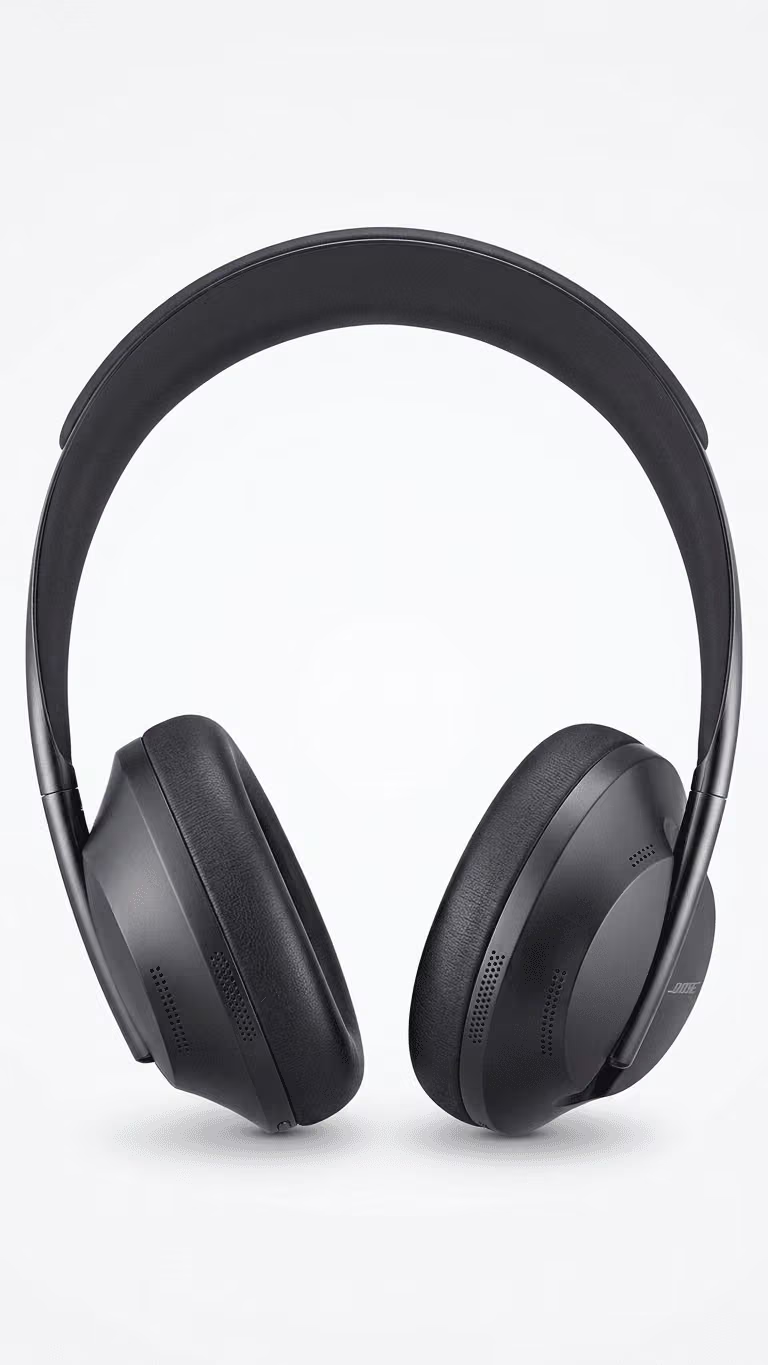
The Bose Noise Cancelling Headphones 700, often shortened to "Bose 700," launched in 2019 as Bose's premium alternative to Sony's WH-1000X series. At the time, they were a serious contender for the top of the active noise-cancelling headphone market, combining highly adjustable ANC, strong call performance, a distinctive design, and a comfortable fit.
The situation is different now.
Bose replaced the Noise Cancelling Headphones 700 as its flagship over-ear headphone with the QuietComfort Ultra Headphones in 2023. Bose has since introduced a second-generation QuietComfort Ultra, while the standard QuietComfort line has also continued to evolve. The 700 is therefore best understood as an older premium headphone that can still make sense at the right price rather than as a current flagship alternative.
- Best for: People who prioritize voice and video calls, want strongly adjustable noise cancellation, and can find a well-maintained Bose 700 at a substantial discount.
- Not ideal for: Buyers who want the latest Bose technology, longer battery life, the newest ANC performance, a compact folding design, or advanced Bluetooth codecs such as aptX or LDAC.
- Biggest strength: Call quality. Multiple independent reviews have consistently highlighted the Bose 700's voice pickup and background-noise handling as one of its strongest characteristics, including comparisons with newer Sony headphones.
- Biggest weakness: Time has caught up with the 700. Newer headphones now offer stronger overall feature sets, longer battery life, and more advanced ANC and audio technologies.
- Current value: Potentially attractive when heavily discounted, particularly for buyers who care about call quality and adjustable ANC. It becomes much harder to justify when its price approaches that of newer, actively supported headphones.
What Is the Bose Noise Cancelling Headphones 700?
Released in 2019, the Bose Noise Cancelling Headphones 700 marked a deliberate departure from Bose's long-running QuietComfort naming and design language.
Bose introduced the 700 with a new industrial design, a stainless-steel headband, touch-sensitive controls, a redesigned noise-cancellation system, and an eight-microphone system designed not only for ANC but also for clearer voice pickup. Bose positioned the headphones as a major technological step forward for its headphone lineup.
The design was notably different from the older QuietComfort 35 II. Rather than using a conventional folding headband, the 700 uses a slimmer, hinge-free structure with earcups that rotate for a flatter carrying position. That makes the headphones visually distinctive but also contributes to a larger travel case.
A business-oriented version, the Bose 700 UC, was also sold with additional conferencing-focused functionality and a Bose USB Link accessory.
The important context for a 2026 buyer is that the 700 is no longer Bose's current flagship.
Bose introduced the QuietComfort Ultra Headphones in 2023 specifically as the replacement for the Noise Cancelling Headphones 700 at the top of its over-ear range. Bose subsequently launched the QuietComfort Ultra Headphones (2nd Gen) in 2025, bringing further improvements to noise cancellation, battery life, audio processing, and connectivity.
That means the Bose 700 should now be evaluated primarily on how much it costs and what you need from it, rather than on whether it can compete feature-for-feature with today's newest flagship headphones.
Price & Availability
The Bose Noise Cancelling Headphones 700 launched in 2019 at $399 in the United States.
Over time, its street price fell substantially as newer Bose and Sony models entered the market. Historical reviews also recorded discounts that brought the 700 considerably below its original launch price. Those historical prices are useful for understanding the product's market position, but they should not be treated as current 2026 pricing.
Because the 700 is now an older model, availability and pricing can vary significantly depending on whether you are looking at:
- New-old-stock inventory
- Refurbished units
- Open-box units
- Used headphones
- Marketplace listings
For a discontinued or aging product, condition can matter almost as much as price.
Before buying a used or refurbished Bose 700, check that:
- The headphones power on normally.
- USB-C charging works.
- Both earcups produce sound.
- Bluetooth pairing works reliably.
- ANC modes function correctly.
- The touch controls respond normally.
- The ear cushions are not excessively worn.
- The included accessories are present if they matter to you.
- The seller offers a reasonable return policy.
Bose's official accessories store currently lists a replacement ear-cushion kit for the Noise Cancelling Headphones 700, which is useful for owners maintaining an existing pair. Availability of accessories for an older product can change, however, so check the current listing before buying specifically because of parts availability.
Price warning: Prices for older and discontinued headphones can fluctuate significantly. Do not treat historical prices mentioned in older reviews as current market prices.
Pros & Cons
- Excellent and highly adjustable active noise cancellation
- 11 selectable ANC levels from 0 to 10
- Strong reputation for voice and video-call performance
- Comfortable fit for many users, with multiple independent reviewers praising long-session comfort
- Distinctive stainless-steel headband and modern design
- Clear, direct, and generally balanced sound presentation
- USB-C charging
- Quick-charge capability
- Supports Alexa, Google Assistant, and Siri access
- Basic EQ controls through the Bose app
- Still a compelling option when found at a substantial discount
- Older product that has been replaced at the top of Bose's lineup
- Newer headphones now offer more advanced ANC, audio processing, and battery performance
- Battery life is only around 19–21 hours in independent testing
- No inward-folding hinge, making the travel case relatively bulky
- Bluetooth codec support is limited to SBC and AAC
- No aptX or LDAC
- Touch controls can be sensitive for some users
- Comfort is not universally agreed upon, with some testers reporting warmth or firmer ear cushions during long sessions
- No official IP rating
- Used and old-stock units require more careful inspection before purchase
Key Specifications
| Specification | Detail |
|---|---|
| Type | Over-ear, closed-back, wireless |
| Launch year | 2019 |
| Original U.S. launch price | $399 |
| Current status | Older model replaced by Bose's QuietComfort Ultra flagship |
| Weight | Approximately 254g |
| Bluetooth | Bluetooth 5.0 |
| Bluetooth codecs | SBC, AAC |
| ANC | Yes |
| ANC levels | 11 levels, 0–10 |
| Microphones | Eight-microphone system |
| Manufacturer battery rating | Up to 20 hours |
| SoundGuys battery test | 21 hours 25 minutes |
| USB charging | USB-C |
| Quick charge | Bose claims up to 2 hours from a 15-minute charge |
| Voice assistants | Alexa, Google Assistant, Siri |
| Touch controls | Yes |
| Folding headband | No |
| Water/IP rating | No official IP rating |
Important: Specifications can vary slightly between regional documentation and testing conditions. More importantly, manufacturer claims and independent measurements should not be treated as interchangeable. For example, Bose's 20-hour figure is a manufacturer claim, while SoundGuys' 21-hour-25-minute result is an independent measurement under its own standardized test conditions.
What Made the Bose 700 Different When It Launched?
The Bose 700's biggest innovation was not simply having ANC. Bose had already been making noise-cancelling headphones for years.
The difference was how much control the 700 gave the listener over that ANC.
The headphones offer 11 selectable noise-cancellation levels, from 0 through 10. Level 10 provides the strongest isolation, while lower levels allow progressively more environmental sound through. What Hi-Fi? found the higher levels particularly effective in noisy environments, while Bose designed the system to make switching between different listening situations easier.
The 700 also introduced a new microphone and signal-processing architecture focused heavily on voice communication.
Bose's original product announcement described an eight-microphone system designed to isolate the user's voice from surrounding noise, with beamforming technology intended to improve voice pickup during calls and interaction with voice assistants.
That emphasis on communication became one of the defining characteristics of the Bose 700.
The question in 2026 is whether those features remain useful.
The answer is yes—but with an important qualification.
The 700's adjustable ANC and strong voice pickup remain useful. What has changed is the competitive landscape around them. Newer headphones now combine similar core features with newer processors, improved adaptive ANC, longer battery life, spatial or immersive audio features, and newer connectivity options.
Main Features
Adjustable Active Noise Cancellation
What it is
The Bose 700 provides 11 ANC levels, from 0 to 10, allowing the listener to adjust how much outside sound is suppressed.
The headphones also include a Conversation Mode that makes it easier to hear the surrounding environment without completely removing the headphones.
How it works
Bose developed a new acoustic and signal-processing system for the 700, supported by an eight-microphone architecture. Six microphones contribute to noise cancellation while the system also uses microphones for voice pickup and communication.
Why it matters
Adjustable ANC is still one of the 700's most practical features.
A commuter may want aggressive noise cancellation on a train, while someone working in an office may prefer a lower setting that maintains some awareness of the environment.
Limitations
The 700 remains very effective at reducing environmental noise, but it is no longer reasonable to describe it as the unquestioned ANC leader.
Newer Bose and Sony headphones have continued to improve noise cancellation. SoundGuys' comparison with the Sony WH-1000XM5, for example, found the newer Sony model ahead overall in isolation performance.
The more accurate 2026 conclusion is: The Bose 700 still has excellent ANC, but excellent is not the same thing as class-leading today.
Call and Voice Quality
What it is
The Bose 700 was designed with unusually strong emphasis on voice communication.
Its microphone system combines noise-rejection processing and beamforming techniques to isolate the user's speech from surrounding sounds.
How it works
Bose's original documentation specifically emphasized the ability of the 700 to isolate a user's voice from unwanted sound during calls and voice-assistant interactions.
Independent reviewers have also repeatedly highlighted the 700's call performance.
Why it matters
This is arguably the most compelling reason to consider the Bose 700 today.
If you spend much of your day in:
- Zoom meetings
- Microsoft Teams calls
- Google Meet
- Phone calls
- Remote-work conversations
then the 700's microphone performance can matter more than having the newest ANC algorithm.
Several independent comparisons have found the Bose 700 particularly strong for voice communication, including comparisons against newer Sony models.
Limitations
Microphone performance is not perfect in every environment.
Aggressive background-noise suppression can sometimes make a person's voice sound processed or compressed. Performance can also vary depending on the environment, microphone positioning, network conditions, and the receiving device.
So the safest conclusion is not that the 700 has the best microphone in every situation, but that: Call quality remains one of the Bose 700's strongest and most consistently praised characteristics.
Sound Signature and Bose Music App EQ
What it is
The Bose 700 produces a relatively clear, direct, and balanced presentation rather than the strongly bass-forward sound associated with some Sony headphones.
The Bose Music app also provides basic EQ controls, allowing adjustment of broad bass, midrange, and treble characteristics.
How it sounds
What Hi-Fi? described the 700's presentation as bold, clear, and upfront, while also criticizing it for lacking some of the depth, texture, and insight offered by newer Sony headphones.
SoundGuys' testing also shows a less bass-heavy presentation than the Sony WH-1000XM5.
This difference is important because it means there is no simple "Bose sounds better" or "Sony sounds better" answer.
Why it matters
Listeners who prefer:
- Clear vocals
- A relatively balanced presentation
- Less emphasis on deep bass
- A direct and energetic presentation
may enjoy the Bose 700.
Listeners who prefer:
- Stronger bass
- A warmer presentation
- Greater bass depth
may prefer Sony's tuning.
Limitations
The Bose app's EQ is useful but basic.
If you want highly detailed sound customization, newer competitors may offer more sophisticated adjustment options.
The other limitation is that the 700's underlying audio performance has not aged as well as its ANC and call capabilities.
What Hi-Fi?'s testing was positive about its clarity, but ultimately placed it behind newer competitors in detail, texture, and overall musical sophistication.
YallaBuy analysis: The 700 does not have bad sound. Its problem is that sound quality is no longer one of the reasons to choose it over newer premium headphones.
Touch Controls and Physical Buttons
The Bose 700 combines touch controls with physical buttons.
The right earcup provides gestures for:
- Play/pause
- Volume adjustment
- Track navigation
- Call controls
Physical buttons handle functions such as power, ANC modes, and voice-assistant access.
Why it matters: This hybrid approach remains one of the more distinctive aspects of the 700. Once learned, touch gestures can be faster than repeatedly reaching for a phone.
Limitations: Touch controls are also one of the more subjective aspects of the product. What Hi-Fi? reported occasional sensitivity and responsiveness issues, while other reviewers found the system easy to learn.
That means the best conclusion is not that the controls are objectively bad or excellent. They are useful once learned, but their sensitivity can take some getting used to.
Comfort and Build
The Bose 700 weighs approximately 254g and uses a stainless-steel headband combined with padded earcups.
Its design is noticeably different from the older QC35 II, with a hinge-free headband structure and earcups that rotate for a flatter carrying position.
Comfort
Comfort is one area where the evidence is generally positive but not unanimous.
What Hi-Fi? rated the 700's comfort highly, and The Master Switch and Headphone.ph also reported positive experiences during extended listening.
At the same time, other testing and owner feedback point to warmth, firmer padding, or greater clamping pressure compared with Bose's older QC35 II.
Build
The stainless-steel headband gives the headphones a distinctive premium appearance and contributes to their rigid structure.
However, the hinge-free design has a practical consequence: the headphones do not collapse inward like some traditional folding headphones.
The earcups can rotate into a flatter carrying position, but the headband itself does not fold into a compact travel shape.
That is why the included case is relatively large.
YallaBuy analysis: The Bose 700 is neither obviously poorly built nor universally praised as exceptionally rugged. Its construction is distinctive and well engineered, but the unusual design creates trade-offs in portability and perceived durability.
Battery Life and Charging
The Bose 700 is rated by Bose for up to 20 hours of battery life.
Independent testing gives us a slightly broader picture.
SoundGuys measured 21 hours and 25 minutes under its standardized test conditions with ANC enabled, while The Master Switch reported approximately 19 hours in its own testing.
That means a realistic interpretation is approximately: 19–21 hours depending on testing conditions, volume, ANC settings, and usage.
Why it matters: That is still enough for a full workday and a long flight. It is not a weak battery by historical premium-headphone standards. The problem is that newer competitors have moved significantly beyond it.
SoundGuys measured more than 31 hours from the Sony WH-1000XM5 under its test conditions, compared with 21 hours and 25 minutes for the Bose 700.
Bose's newer flagship generation has also improved battery performance.
Quick charging
Bose advertises quick charging through USB-C, with up to two hours of playback from a 15-minute charge under its specified conditions.
YallaBuy analysis: Battery life is adequate rather than exceptional. If you mainly use the headphones for commuting, work, and flights, the 700 can still work well. If you travel for several days without reliable access to a charger, newer models are a better fit.
Connectivity and Codec Support
The Bose 700 uses Bluetooth 5.0 and supports the SBC and AAC Bluetooth codecs.
It can also be used with a wired connection through its included audio cable.
What this means: AAC is particularly relevant to Apple-device users, while SBC provides broad compatibility. The wired connection can also be useful with devices or entertainment systems where Bluetooth is unavailable.
Limitations: The 700 does not support higher-profile codecs such as:
- aptX
- aptX HD
- LDAC
That does not mean the headphones automatically sound bad. Codec support is only one part of wireless audio performance. However, buyers specifically looking for advanced Bluetooth codec support have better options available today.
Independent Performance Summary
Because this review combines multiple independent sources rather than treating one review as definitive, the evidence looks like this:
| Category | What the evidence suggests |
|---|---|
| Noise cancellation | Excellent overall, but newer flagship headphones have surpassed it in overall ANC performance |
| Battery life | Bose claims 20 hours; SoundGuys measured 21h25m; other testing has produced results around 19 hours |
| Call quality | One of the 700's strongest areas, with multiple reviewers praising voice pickup and background-noise handling |
| Sound | Clear, direct, and generally balanced, but newer competitors can offer greater depth, detail, and bass extension |
| Comfort | Generally comfortable, but some testers report warmth, firmer padding, or stronger clamp than the older QC35 II |
| Build | Distinctive stainless-steel construction with a premium appearance, but the unusual hinge-free design sacrifices folding portability |
| Controls | Useful hybrid touch/physical system, although touch sensitivity can vary by user |
| Connectivity | Reliable basic Bluetooth implementation, but codec support is limited by modern standards |
Because comfort, sound, and even ANC impressions can vary between testers and environments, this should be treated as a directional evidence summary, not a laboratory ranking.
Owner and Retail Feedback Patterns
Owner feedback requires more caution than professional testing.
The Bose 700 has been on the market since 2019, and today's listings include a mixture of older owner reviews, retailer feedback, refurbished units, and used-market experiences.
Recurring positive themes
Owners and reviewers commonly praise:
- Noise cancellation
- Call quality
- Comfort
- Design
- Touch controls
- General ease of use
Recurring concerns
Some owners report:
- App or Bluetooth pairing frustrations
- Warmth during long listening sessions
- Touch-control sensitivity
- Battery degradation in older units
- Problems appearing on heavily used or poorly maintained secondhand units
The last point is particularly important for 2026 buyers.
A used headphone that has been heavily used for several years should not be assumed to have the same remaining lifespan as a lightly used example.
Reliability caution
If buying secondhand, test:
- Charging
- Power-on behavior
- Bluetooth pairing
- Both channels
- ANC
- Microphones
- Touch controls
- Physical buttons
This is more useful than assuming a particular failure rate from a collection of resale listings.
About historical Bose firmware issues
Some older Bose QuietComfort models were the subject of reports concerning firmware updates and changes in ANC performance.
Those reports should not be treated as evidence that the Bose 700 has the same problem.
They are mentioned only to illustrate why software-dependent headphones can sometimes change behavior after firmware updates.
YallaBuy did not conduct a structured survey of Bose 700 owners, so these observations should be understood as patterns in publicly available feedback, not a scientific reliability study.
Problems & Limitations
1. It is an older generation
This is the biggest consideration in 2026.
The 700 was designed around the technology landscape of 2019. Bose has since released multiple generations of QuietComfort products, including the QuietComfort Ultra line and the 2026 QuietComfort Headphones (2nd Gen).
2. ANC is no longer class-leading
The 700 remains very good at blocking environmental noise, but newer headphones can deliver stronger overall isolation.
3. Battery life is modest by current flagship standards
Around 19–21 hours in independent testing is usable, but modern competitors can provide substantially more.
4. The design is not compact
The earcups rotate for a flatter carrying position, but the headphones do not fold inward like the QC35 II.
5. Bluetooth codec support is limited
There is no aptX or LDAC.
6. EQ customization is basic
The Bose app provides useful broad tone adjustments, but it is not designed for highly detailed sound shaping.
7. Comfort can vary
Many reviewers find the 700 comfortable, but some report heat buildup, firmer padding, or stronger clamp during extended sessions.
8. No official IP rating
The Bose 700 should not be treated as a waterproof or water-resistant sports headphone.
The absence of an official IP rating means buyers should avoid intentionally exposing it to significant moisture, sweat, or water.
Who Should Buy It?
Remote workers and frequent callers
If clear voice communication is more important to you than having the newest ANC system, the Bose 700 remains interesting.
Buyers finding a genuinely good deal
A discounted, verified-working unit can be attractive when its price is substantially below newer premium headphones.
Commuters and travelers
The ANC remains strong enough to make the 700 useful for trains, planes, offices, and other noisy environments.
Listeners who prefer a less bass-heavy sound
If you prefer a clear and relatively balanced presentation instead of a warmer, bassier tuning, the Bose 700 may suit you better than some Sony alternatives.
Who Should Not Buy It?
Buyers who want the latest Bose technology
Bose's current flagship is the QuietComfort Ultra Headphones (2nd Gen), while the newer QuietComfort line also offers current-generation products.
Buyers who prioritize maximum battery life
Newer Sony and Bose models offer substantially longer endurance.
Buyers who want the newest ANC performance
The 700 is still strong, but newer flagship models have moved ahead.
Buyers who need advanced Bluetooth codecs
If aptX or LDAC is important to you, the Bose 700 is not the right choice.
Buyers who want compact travel headphones
The lack of an inward-folding hinge makes the 700 less space-efficient than some competitors.
Buyers who do not want used or old-stock electronics
If you want the simplest possible warranty and support experience, choosing a current model is the safer route.
Alternatives
Bose QuietComfort Ultra Headphones (2nd Gen)
This is the most obvious Bose alternative if you want the technology that came after the 700.
The second-generation QuietComfort Ultra is Bose's current premium flagship and adds newer noise-cancellation processing, Bose Immersive Audio, improved battery life, and lossless USB-C audio among other changes. Bose launched it in 2025 at $449.
Choose it over the 700 if: you want the latest Bose flagship technology.
Choose the 700 instead if: you find it dramatically cheaper and primarily care about calls, adjustable ANC, and its distinctive design.
Sony WH-1000XM5
The Sony WH-1000XM5 remains one of the most important alternatives to the Bose 700.
SoundGuys' direct comparison found the Sony substantially ahead in battery life, measuring 31 hours and 53 minutes compared with 21 hours and 25 minutes for the Bose 700.
Sony also provides a more bass-forward default sound signature.
Choose the XM5 if: battery life, newer technology, and strong overall ANC matter more.
Choose the Bose 700 if: voice-call performance and its distinctive control/design approach matter more to you.
Sony WH-1000XM4
The XM4 is worth considering if you want Sony's feature set and sound signature without necessarily moving to the latest flagship.
Its age also means the same basic rule applies as with the Bose 700: condition, warranty, and current price matter enormously.
Bose QuietComfort Headphones (2nd Gen)
Bose introduced the second-generation QuietComfort Headphones in August 2026.
The new model brings Bose's latest standard QuietComfort platform, including updated design, Bose TrueSpatial Technology, multiple listening modes, Bluetooth multipoint, and a manufacturer-rated 24-hour battery life. Bose lists a $359 launch price.
Choose it if: you want a current Bose product but don't need the premium flagship positioning of the QuietComfort Ultra 2nd Gen.
Value for Money
The Bose 700's value proposition has changed completely since launch.
In 2019, $399 bought one of Bose's flagship noise-cancelling headphones.
In 2026, the question is different: How cheap does the 700 need to be before its remaining strengths outweigh its age?
There is no universal dollar threshold because used and old-stock pricing varies by condition and seller.
The basic rule is more useful:
The 700 makes sense when:
- It is substantially cheaper than current alternatives.
- The unit is verified to work correctly.
- You have a good return policy.
- Call quality matters to you.
- You specifically like Bose's adjustable ANC.
- You prefer its sound signature and design.
The 700 makes less sense when:
- Its price approaches a current-generation headphone.
- It has no meaningful warranty or return protection.
- The battery shows signs of degradation.
- You want the newest ANC.
- You need long battery life.
- You want current-generation connectivity and audio features.
YallaBuy analysis: Don't buy the Bose 700 simply because it used to be a $399 flagship. Buy it only if the current price makes sense for what the older hardware can still do.
Final Verdict
The Bose Noise Cancelling Headphones 700 earned its reputation for good reasons.
Its adjustable noise cancellation remains useful. Its design still looks distinctive. Its call performance remains one of its strongest characteristics. And multiple independent reviewers have found the headphones comfortable enough for long listening sessions.
But the Bose 700 is no longer a current flagship.
Bose itself moved beyond the 700 with the QuietComfort Ultra line, and the company's current flagship has now reached its second generation.
Independent testing also shows where the 700 has aged most clearly: battery life and overall noise-cancellation performance are no longer competitive with the newest premium models. Sound quality remains perfectly respectable, but newer headphones can deliver greater depth, refinement, and flexibility.
That makes the Bose 700 a conditional recommendation rather than a universal one.
Buy it if: You can find a well-priced, verified-working unit and your priorities are call quality, adjustable ANC, comfortable everyday use, and the Bose 700's distinctive design.
Skip it if: You want the newest technology, maximum battery life, the latest ANC performance, advanced Bluetooth codecs, or the reassurance of buying a current-generation product with straightforward manufacturer support.
The Bose 700 is no longer the headphone to buy simply because it is a former flagship. It can still be the right headphone if you buy it for the right reasons and at the right price.
FAQ
The Bose 700 has been replaced at the top of Bose's over-ear lineup by the QuietComfort Ultra series. Bose announced the QuietComfort Ultra Headphones in 2023 as the replacement for the Noise Cancelling Headphones 700. For a 2026 buyer, the 700 should therefore be treated as an older-generation product rather than Bose's current flagship.
It can be, but mainly at a substantial discount. Its strongest reasons to buy are call quality, adjustable ANC, and its distinctive design. If you want the newest Bose technology, longer battery life, or the latest ANC performance, a current model is the safer choice.
Bose rates the headphones for up to 20 hours. SoundGuys measured 21 hours and 25 minutes under its standardized test conditions, while The Master Switch reported approximately 19 hours in its own testing. A reasonable expectation is therefore roughly 19–21 hours, depending on volume, ANC settings, and usage conditions.
No. The Bose 700 supports SBC and AAC Bluetooth codecs but does not support aptX or LDAC.
It depends on what you prioritize. The Bose 700 has a particularly strong reputation for call quality, while the Sony WH-1000XM5 offers significantly longer battery life and stronger overall performance in SoundGuys' direct ANC comparison. If calls are your priority, the Bose remains compelling. If battery life, newer technology, and overall ANC performance matter more, the Sony is the stronger choice.
No. The headphones do not have an official IP rating, so they should not be treated as waterproof or designed for intentional water exposure.
Bose's U.S. accessories store currently lists replacement ear cushions for the Noise Cancelling Headphones 700. Availability can change for an older product, so check Bose's current inventory before purchasing a used pair specifically because replacement parts are available.
Yes. This is one of its strongest use cases. The 700 was specifically engineered around voice pickup and background-noise rejection, and independent reviews have repeatedly praised its call performance. That does not guarantee perfect microphone performance in every environment, but it remains one of the strongest reasons to consider the 700 today.