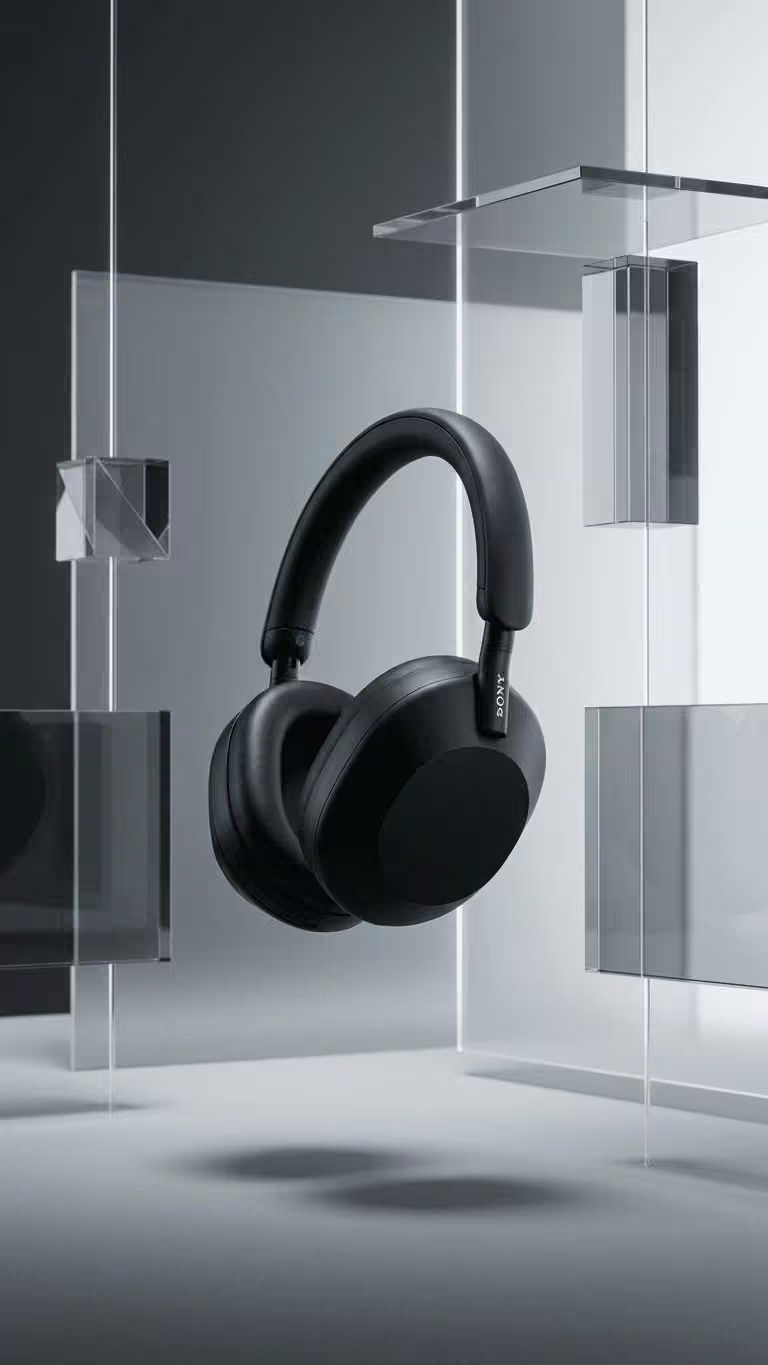
Amazon prices can change frequently and may change from day to day. The price displayed here may not always match the current price on Amazon. Always check the current Amazon price, seller, availability, and product condition before purchasing.
- Short Answer
- Editorial Transparency
- At a Glance
- What Is the XM5?
- Worth Buying in 2026?
- Design & Build
- Comfort
- Hinge & Durability
- Sound Quality
- EQ & LDAC
- Noise Cancellation
- ANC in Different Environments
- Microphone & Calls
- Battery Life
- Multipoint Bluetooth
- Sony Sound Connect App
- Smart Features
- Wired Listening
- Use Cases
- Comparisons
- Strengths & Weaknesses
- 5 Reasons to Buy / Not Buy
- Who Should Buy / Skip
- Value Discussion
- Final Pros & Cons
- Final Verdict
- FAQ
Yes — but only if you buy it at the right price. The Sony WH-1000XM5 is still a highly capable pair of premium wireless noise-canceling headphones in 2026. It offers excellent active noise cancellation, very good sound quality, strong microphone performance, useful smart features, multipoint Bluetooth, LDAC support, and up to 30 hours of advertised battery life with noise cancellation enabled. Sony lists the headphones at approximately 250g and equips them with 30mm drivers and multiple microphones controlled by two processors.
But there is a major reason why the buying decision is more complicated today than it was when the XM5 first launched:
The Sony WH-1000XM6 now exists.
The XM6 is the direct successor to the XM5 and improves several areas, including the design, hinge, connectivity, sound, and battery performance according to independent testing.
So the real question in 2026 isn't simply "Is the Sony WH-1000XM5 good?" It is. The better question is: "Is the WH-1000XM5 cheap enough compared with the newer XM6 to make buying the older model worthwhile?"
For the right buyer and the right price, the answer can absolutely be yes.
YallaBuy Editorial Transparency
YallaBuy has not personally tested the Sony WH-1000XM5. We did not use the headphones ourselves, perform laboratory measurements, conduct our own ANC measurements, or independently measure battery life.
Instead, this article analyzes the product using Sony's official specifications and information from independent testing and review publications, including RTINGS and SoundGuys.
When this article discusses measurements, battery results, noise-isolation results, or other testing data, those results belong to the cited testing source rather than YallaBuy.
We believe this distinction matters. A product review should not imply that a website personally tested something when it did not. Our goal with this guide is therefore not to pretend that YallaBuy performed tests that it did not perform. Instead, we look at the available evidence and explain what that evidence means for someone considering buying the WH-1000XM5.
Amazon Price Disclaimer
Amazon prices can change frequently and may change from day to day. The price displayed on YallaBuy may not always match the current price on Amazon. Amazon prices can change because of promotions, discounts, sellers, availability, product condition, and other factors.
Before purchasing the Sony WH-1000XM5, always check the current Amazon price, seller, availability, shipping information, and product condition on the Amazon product page.
If you see a lower or higher price than the one mentioned in this article, the Amazon listing should be considered the most current price. The price is not fixed. Always check Amazon before buying.
Sony WH-1000XM5 at a Glance
| Type | Over-ear wireless headphones |
|---|---|
| Noise cancellation | Active Noise Cancellation |
| Driver | 30mm |
| Weight | Approx. 250g |
| Bluetooth | Bluetooth 5.2 |
| High-quality codec | LDAC |
| Other codecs | SBC, AAC |
| Battery with ANC | Up to 30 hours |
| Battery without ANC | Up to 40 hours |
| Charging | USB-C |
| Wired connection | 3.5mm stereo mini jack |
| Multipoint | Yes |
| Microphones | Multiple microphones with beamforming |
| App | Sony Sound Connect |
| EQ | Yes |
| DSEE Extreme | Yes |
| Foldable | Yes, with carrying case |
| Release generation | 2022 flagship |
| Current successor | WH-1000XM6 |
What Is the Sony WH-1000XM5?
The WH-1000XM5 is Sony's fifth-generation flagship over-ear noise-canceling headphone in the company's famous 1000X series. It was designed around a simple idea: Give users a quiet environment for music, calls, travel, work, and everyday listening.
Instead of focusing on one feature, Sony built the XM5 as an all-rounder. It combines:
- Active noise cancellation
- Wireless audio
- High-quality Bluetooth codecs
- Multiple microphones
- Voice pickup technology
- Adaptive controls
- Multipoint connectivity
- Smartphone integration
- EQ customization
- Long battery life
- Wired listening
That combination is what made the XM5 so popular. And that combination is also why it hasn't suddenly become a bad headphone just because a newer generation exists. Technology products don't automatically become useless when the next generation arrives. A newer model can be better while the previous model remains excellent.
The important question is how much the older model costs.
The First Question: Is the XM5 Still Worth Buying in 2026?
The answer depends heavily on price. Imagine two situations.
Situation A
The WH-1000XM5 is significantly cheaper than the XM6. In that situation, the XM5 can be a very attractive purchase. You get premium ANC, strong sound quality, good microphones, multipoint Bluetooth, LDAC, and a mature software ecosystem without paying for the newest generation.
Situation B
The XM5 and XM6 are almost the same price. Now the calculation changes. The XM6 has a redesigned hinge and headband, newer connectivity features, and improvements in sound, battery, and other areas. In that situation, spending a little more for the newer model can make much more sense.
So we would not recommend buying the XM5 simply because it has a famous name. Buy it because the price makes sense.
Design and Build Quality
Sony completely redesigned the physical appearance of the XM5 compared with the XM4. The XM5 has a cleaner, more minimalist appearance. The earcups and headband look more integrated, with fewer visible mechanical elements.
This gives the headphones a modern appearance that doesn't scream "technology." They can look appropriate in several environments:
- Office
- University
- Airport
- Café
- Public transportation
The design is relatively understated. That's a strength for people who don't want enormous gaming-style headphones.

The 250g Weight
The XM5 weighs approximately 250 grams. That's light enough for a premium over-ear ANC headphone, and weight is an important factor when you're wearing headphones for several hours. A headphone can have excellent sound but still become annoying if the weight or clamping force makes your head uncomfortable.
The XM5 generally avoids that problem. However, weight is only one part of comfort. Headband pressure, earcup depth, earcup temperature, and the shape of your head all affect comfort. This is why two people can wear the same headphones and have completely different experiences.
Comfort for Long Listening Sessions
One of the biggest reasons people choose premium over-ear headphones instead of earbuds is long-term comfort. The XM5 surrounds your ears instead of placing the speaker directly inside the ear canal.
For many people, this makes several-hour listening sessions easier. You can use the headphones for studying, office work, long flights, trains, movies, podcasts, music, online classes, and video calls.
But the XM5 isn't perfect for every head shape. RTINGS notes that people with smaller heads may experience pressure from the headband during longer listening sessions. That's an important limitation. A specification sheet cannot tell you whether a headphone will fit your head perfectly.
If comfort is your top priority, trying the headphones before purchasing is ideal.
The Ear Cushions
The ear cushions are designed to surround the ears. This serves two purposes. First, it improves comfort by avoiding direct pressure on the ears. Second, it contributes to passive isolation.
Passive isolation means the physical headphone design blocks some outside sound before the electronic ANC system even does anything. This matters because ANC works together with the physical seal. If the seal is poor, especially around glasses or hair, the headphone may not isolate outside noise as effectively.
So ANC performance isn't only about the microphones and processors. Fit matters.
The Folding Design
The XM5 can be folded for transportation and comes with a carrying case. That makes it more practical for travel than a large headphone that simply sits in a backpack without protection. Sony lists a carrying case, headphone cable, and USB charging cable among the box contents.
The case is more than an accessory. If you're spending several hundred dollars on headphones, protecting them from being crushed inside a backpack is a good idea.
The Hinge and Durability Question
This is one of the most important weaknesses to understand before buying the XM5. The XM5's design has received criticism regarding durability around its hinges and arms.
This doesn't mean every XM5 will break. It also doesn't mean the headphones are inherently unusable. But it means buyers who frequently throw their headphones into bags, bend them aggressively, or travel constantly should be more careful.
The newer XM6 introduces a redesigned hinge and sturdier construction. There are also recent user reports on Sony's site describing broken arms after extended use, although individual user reports shouldn't be treated as representative laboratory evidence.
What should you do?
- Use the carrying case.
- Don't force the earcups.
- Don't sit on the headphones.
- Don't aggressively bend the headband.
- Don't throw them into a backpack without protection.
If you're hard on your electronics, the XM6 deserves extra consideration.
Sound Quality
Sound quality is one of the most subjective parts of any headphone review. There isn't a single sound signature that everybody prefers. Some listeners want strong bass, warm vocals, detailed treble, neutral tuning, wide soundstage, or powerful sub-bass.
The XM5 attempts to provide an enjoyable consumer-friendly sound while giving users EQ controls through Sony's app. Sony uses a specially designed 30mm driver and a carbon-fiber-composite material in the driver structure.
Bass Performance
The XM5 has enough bass to make modern music enjoyable. Electronic music, hip-hop, pop, and many movie soundtracks can benefit from the low-end response. But the XM5 isn't simply a "bass monster."
Independent testing generally describes its default tuning as somewhat bass-emphasized but more balanced than some heavily bass-focused alternatives. That makes the XM5 more versatile. You can listen to bass-heavy music without completely sacrificing vocals and instruments.
Vocals and Midrange
The midrange is where voices and many instruments live. For podcasts, YouTube videos, interviews, and vocals, this matters more than extreme bass. The XM5 provides a generally enjoyable presentation, although its tuning isn't completely neutral. For everyday listening, this means you shouldn't expect the XM5 to sound like a studio reference headphone. It is designed more as a premium consumer headphone.
Treble
Treble affects details such as cymbals, high-pitched instruments, some vocal details, sibilance, and air and brightness. The XM5 provides enough high-frequency detail to make music sound lively without making the headphone purely focused on analytical listening. Again, personal preference matters. Someone who likes a warm sound may love it. Someone who wants a very neutral studio-like sound may prefer another headphone.
Can You Change the Sound?
Yes. This is one of the XM5's strongest features. Sony's companion app allows users to customize the sound using EQ. That means you don't have to accept the default sound completely. For example, someone who wants more bass can increase the low frequencies. Someone who wants a more neutral presentation can reduce the bass and adjust other frequencies. This flexibility makes the XM5 more useful for different listeners.
LDAC Support
The XM5 supports LDAC, Sony's high-quality Bluetooth codec. Sony lists LDAC alongside SBC and AAC. LDAC can provide higher bitrate Bluetooth transmission when the source device and connection conditions support it.
But there is an important point that gets lost in many headphone articles: LDAC doesn't automatically make everything sound dramatically better. You need: a compatible source device, compatible software/settings, appropriate audio content, and a stable enough wireless connection.
If you're using an iPhone, LDAC isn't the main reason to buy the XM5. For Android users, however, LDAC can be a useful advantage.
DSEE Extreme
Sony also includes DSEE Extreme. The basic idea is to use digital processing to improve the perceived quality of compressed audio. This can be useful for users who frequently stream compressed music. But again, it isn't magic. It can't turn a low-quality recording into a true high-resolution studio recording. Think of it as audio processing rather than a replacement for high-quality source material.
Looking for the best current price on the Sony WH-1000XM5?
Check Price on Amazon →Noise Cancellation: The Main Reason to Buy the XM5
If you asked us to identify the single biggest reason to buy the XM5, it would be: Noise cancellation.
Sony designed the XM5 around ANC. The headphones use multiple microphones and two processors to control the noise-canceling system. Sony also uses an Auto NC Optimizer that adjusts noise cancellation based on wearing conditions and the surrounding environment.
RTINGS currently describes the XM5's noise isolation as outstanding and says it can significantly reduce a broad range of environmental noise, including office chatter and bus engines. That's a big deal.
How the XM5 Performs in Different Environments
On an Airplane
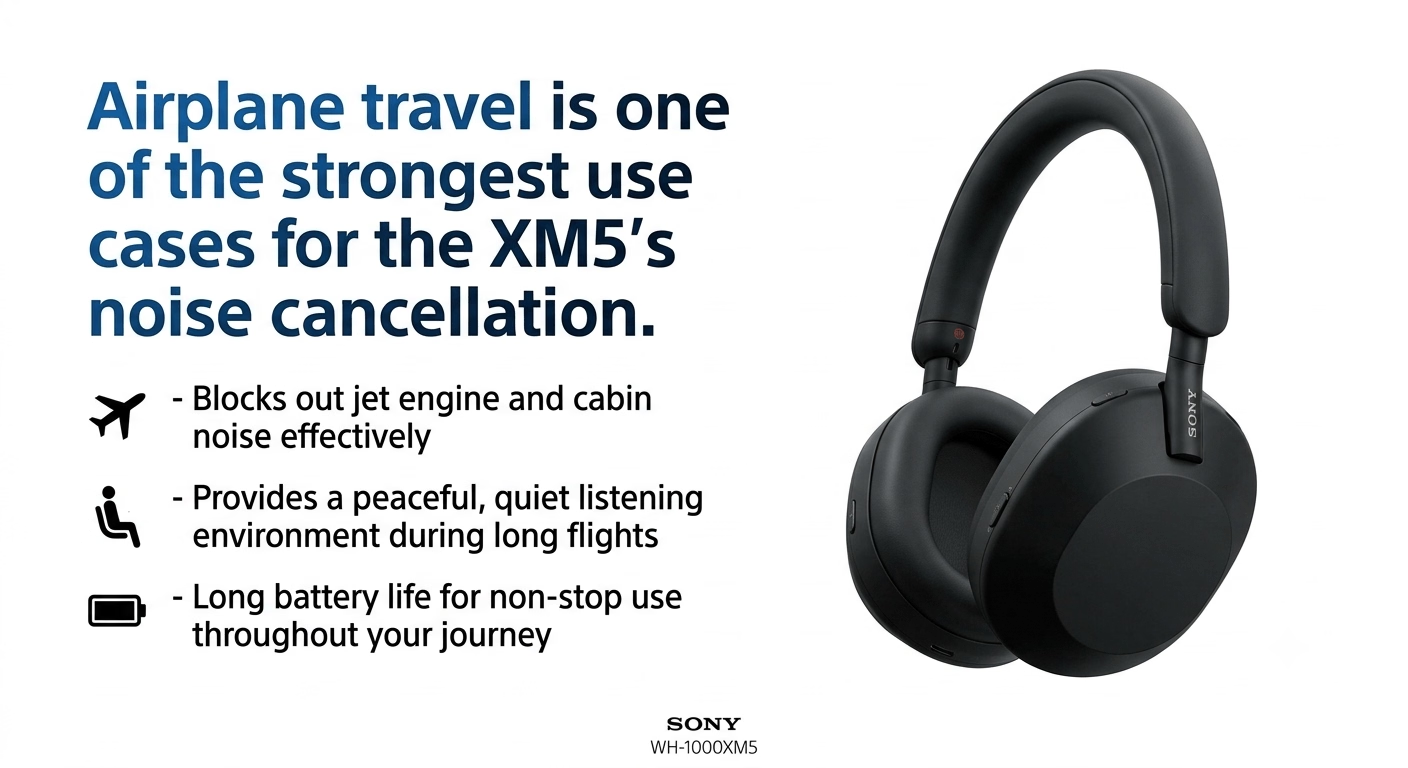
Airplane cabins are one of the environments where ANC headphones make the most sense. The low-frequency engine rumble is exactly the kind of continuous sound ANC can be effective against. The XM5 can substantially reduce that background noise. The result isn't complete silence. Instead, the constant rumble becomes much less intrusive. This allows you to focus more easily on music, movies, podcasts, sleep, reading, or work. For frequent travelers, this alone can justify the purchase.
On Trains and Buses
Public transportation creates a mixture of sounds: engine noise, tire noise, air conditioning, conversations, and mechanical sounds. The XM5 performs well against many of these sounds. However, ANC isn't equally effective against every sound. A sudden loud conversation or nearby high-frequency sound may still be audible. That's normal.
In an Office
This is another strong use case. Imagine you're working in an open office. People are talking around you. A printer is running. Air conditioning is operating. Chairs are moving. The XM5 can reduce a large portion of that background environment. That doesn't mean you won't hear coworkers. It means the overall background becomes less distracting. If your primary goal is concentration, this can be more valuable than a small difference in sound quality.
Can ANC Block Human Voices?
This is where expectations need to be realistic. ANC tends to be especially effective against predictable, continuous sounds. Human speech is more complicated. Voices contain many frequencies and change rapidly. The XM5 can reduce voices, but you may still hear people around you. This is especially true when someone is speaking directly next to you.
So don't buy ANC headphones expecting "I won't hear another human being." That's not realistic. A better expectation is: "The environment will become significantly quieter."
Ambient Sound Mode
Sometimes you don't want silence. If you're walking through an airport, crossing a street, or waiting for someone, you may need to hear your surroundings. The XM5 provides ambient sound functionality that allows external sound into the headphones. This is much safer and more convenient than constantly removing the headphones.
Quick Attention
Another useful feature is the ability to quickly lower your music and hear what's happening around you. This is useful when someone talks to you, a cashier asks you a question, you need to hear an announcement, or you want to hear your surroundings briefly. It removes the need to take the headphones off every time.
Microphone and Call Quality
Sony made a significant effort to improve the XM5's microphone system. Sony says the XM5 uses four beamforming microphones and an AI-based noise-reduction algorithm for voice pickup, alongside a wind-noise-reduction structure.
This is one of the areas where the XM5 became particularly attractive compared with older Sony models.
Is the XM5 Good for Phone Calls?
Yes. If you frequently take calls while commuting or working, the XM5 is a strong option. The microphone system attempts to focus on your voice while reducing surrounding noise. That makes it useful for phone calls, work meetings, online classes, video calls, customer calls, and remote work.
Of course, microphone performance depends on the environment. A quiet office is easier than a windy street.
Zoom, Google Meet, and Microsoft Teams
The same microphone technology that helps with phone calls can make the XM5 useful for online meetings. If you're a student attending online classes or a remote worker participating in meetings, this can be an important advantage. But if professional voice quality is your primary concern, a dedicated USB microphone will usually give you more control. The XM5 is an all-in-one solution. It isn't a studio microphone.
What About Wind?
Wind is a difficult problem for ANC headphones because microphones can pick up wind turbulence. Sony specifically added a wind-noise-reduction structure to the XM5's microphone system. That helps during calls. But wind can still affect ANC performance and microphone clarity. Again, technology reduces the problem. It doesn't make physics disappear.
Battery Life
Battery life is another major strength. Sony officially rates the WH-1000XM5 for up to 30 hours with ANC enabled. With ANC disabled, Sony rates it for up to 40 hours. That's enough for most people's normal usage.
Real-World Battery Testing
Independent testing can produce different results from manufacturer specifications because laboratories use different conditions. SoundGuys measured approximately 31 hours and 53 minutes with ANC enabled in its testing of the XM5. That is a very strong result. In other words, the XM5 isn't just relying on an optimistic manufacturer claim. Independent testing also demonstrates strong endurance.
Is 30 Hours Enough?
For most people, absolutely. Consider a person using the headphones for 4 hours per day. Thirty hours of battery would theoretically represent more than a week of listening before needing to recharge, although actual battery life varies with volume, settings, calls, codec, and other conditions.
For a traveler, 30 hours is also enough for a long trip. For someone who works eight hours per day with ANC, it is still several workdays.
Fast Charging
Fast charging is another useful feature. If you forget to charge your headphones before leaving the house, a short charging session can give you meaningful playback time. This is especially useful when traveling. You don't necessarily need to wait for the headphones to reach 100%.
Multipoint Bluetooth
One of the most useful everyday features of the XM5 is multipoint connectivity. You can connect the headphones to two devices. For example: Laptop + Smartphone.
You might be listening to music from your laptop. Then your phone receives a call. The headphones can switch between the devices. This eliminates a lot of manual Bluetooth management.
Why Multipoint Matters More Than Specifications
Specifications are easy to advertise. Real-world convenience is harder to measure. Multipoint is one of those features that doesn't sound exciting on a product page. But once you use it every day, it becomes difficult to give up. For students and office workers who constantly switch between a phone and computer, it can save time.
Sony Sound Connect App
The XM5 works with Sony's companion application. The app gives users control over many headphone features. Depending on the supported software version and device, users can manage things such as:
- Noise cancellation
- Ambient sound
- EQ
- Connection settings
- Adaptive features
- Firmware updates
Sony continues to provide firmware and support resources for the XM5. This software support is one reason the XM5 continues to feel like a modern headphone rather than an abandoned older product.
Smart Features
Speak-to-Chat
Speak-to-Chat is designed around a simple idea. When you begin speaking, the headphones can automatically lower or pause audio so you can interact with someone. It sounds like a small feature. But imagine you're studying in a library and someone asks you a question. Instead of removing your headphones and adjusting the volume manually, the system can react to your voice.
Some people love this. Others disable it because they accidentally trigger it while talking or humming. Fortunately, features like this can be configured.
Auto Pause
The XM5 can detect when you're wearing the headphones and can use that information to control playback. Again, this is a convenience feature rather than something that changes audio quality. But small convenience features add up.
Touch Controls
The XM5 uses touch controls instead of a traditional collection of physical buttons. This allows users to control things such as play/pause, track skipping, volume, calls, and noise control. Some people prefer touch controls because they feel modern. Others prefer physical buttons because they provide tactile feedback. This is mostly personal preference.
Wired Listening
The XM5 includes a 3.5mm stereo mini jack according to Sony's specifications. That gives you another way to use the headphones. This can be useful when Bluetooth isn't allowed, you're connecting to certain airplane systems, your battery is low, or you prefer a wired connection.
However, wired functionality should not be confused with being a traditional passive audiophile headphone. The XM5 is primarily designed as an active electronic wireless headphone.
Use Cases
Is the XM5 Good for Gaming?
This depends on the type of gaming. For casual gaming, the XM5 can be enjoyable. The sound quality is good, the over-ear design is comfortable for many people, and the ANC can be useful when gaming in a noisy environment.
But competitive gaming introduces another issue: latency. Bluetooth headphones aren't always the best choice for competitive gaming where every millisecond matters. If you're playing competitive FPS games and need extremely precise audio timing, a dedicated wired gaming headset may be a better choice. For story games, RPGs, casual gaming, console entertainment, and movies, the XM5 is much more suitable.
Is It Good for Movies?
Yes. The combination of large over-ear design, ANC, strong bass, detailed sound, and comfortable fit makes the XM5 a good personal movie-watching headphone. ANC is especially valuable if you're watching a movie in a noisy environment.
Is It Good for Students?
The XM5 can be an excellent student headphone if the budget allows it. Consider a student studying in a dorm, library, café, shared bedroom, or on public transportation. Noise cancellation can make studying easier. Multipoint is also useful because students often switch between a phone and laptop. The only major problem is price. A student who doesn't need premium ANC may get better value from a cheaper model.
Is It Good for Working From Home?
Yes. The XM5 is particularly useful for people working in shared spaces. You get ANC, good microphone, multipoint, comfortable over-ear design, and long battery life. The combination is more important than any single feature.
Is It Good for Travel?
This is probably one of its best use cases. A traveler can benefit from almost every major feature: ANC reduces airplane and transportation noise, battery supports long trips, comfort makes long listening sessions easier, microphone is useful for calls, multipoint lets you connect to phone and laptop, and the carrying case makes transportation safer. The XM5 was built for this kind of use.
Is It Good for Office Workers?
Yes. For office workers, the most important features aren't necessarily sound quality. They're noise cancellation, microphone, multipoint, comfort, and battery. The XM5 performs strongly in all of these areas.
Is It Good for Audiophiles?
This is more complicated. If you are an audiophile who cares primarily about neutral frequency response, wired amplification, lossless playback, extremely wide soundstage, and detailed technical performance, you may want to look elsewhere. The XM5 is a premium consumer wireless headphone. Its strength is not being the most technically specialized headphone available. Its strength is doing many things well.
Is It Good for Podcast Listeners?
Definitely. Podcasts don't require extreme audiophile performance. They benefit from clear voices, good comfort, strong battery, and noise cancellation. The XM5 is very good at this combination.
Is It Good for YouTube and Netflix?
Yes. The same strengths apply. Noise cancellation helps when watching videos in noisy environments. The comfortable over-ear design works well for long sessions. Movies can benefit from the immersive effect of ANC and over-ear sound. You can also use the headphones at night without disturbing people around you.
Sound Leakage
The closed-back design provides good isolation. RTINGS reports good leakage performance, with leakage generally staying low enough that people nearby shouldn't hear much in a quiet room at normal listening levels. This makes the XM5 useful in shared environments such as libraries and offices. Still, extremely high volume can cause leakage.
Is the XM5 Waterproof?
No. These are not sports earbuds designed around water resistance. Don't treat them like waterproof equipment. If you're sweating heavily during exercise or using them outdoors in rain, take appropriate care.
Can You Exercise or Sleep With Them?
You can exercise with them, but they aren't ideal for serious workouts. They're relatively large and designed primarily for travel, work, and everyday listening. Some people do sleep with them, but over-ear headphones aren't ideal for side sleeping. The earcups take up space and can press against a pillow.
Comparisons
XM5 vs XM4
The XM4 is the previous generation. Both models remain popular. The XM5 brings improvements in areas such as microphone quality, design, noise cancellation, call performance, and sound processing. However, the XM4 has one important advantage: It can be significantly cheaper. So if you find an XM4 at a dramatically lower price, it can still make sense.
XM5 vs XM6
This is the comparison that matters most in 2026. The XM6 is the direct successor. The XM6 introduces a redesigned hinge and flatter headband, offering a sturdier build and changes in comfort.
Independent testing also found advantages for the XM6 in sound, battery, and connectivity, while ANC performance remains highly competitive between the generations.
Battery testing is another interesting difference. SoundGuys measured about 37 hours and 14 minutes for the XM6 with ANC enabled compared with approximately 31 hours and 53 minutes for the XM5.
That doesn't make the XM5 bad. It means the XM6 is a meaningful upgrade.
So Which One Should You Buy?
- If XM5 is much cheaper: Buy XM5.
- If XM5 is moderately cheaper: Compare the actual features and decide whether the savings justify buying the older model.
- If XM5 and XM6 are close in price: Buy XM6.
This is the most important recommendation in this entire article.
XM5 vs Bose QuietComfort Ultra
Bose is one of Sony's biggest competitors in the premium ANC headphone market. The Bose QuietComfort line is famous for comfort and noise cancellation. Sony's advantage is its extensive software ecosystem, LDAC, multipoint features, EQ customization, and strong overall feature package. Bose can be attractive if comfort and Bose's particular ANC/sound presentation are more important to you. There isn't one universal winner. The best choice depends on price, fit, sound preference, ANC preference, phone ecosystem, and software features.
XM5 vs AirPods Max
Apple's AirPods Max are another premium option. If you're deeply invested in Apple's ecosystem, AirPods Max can provide attractive integration. But the Sony has important advantages for users who want lower weight, Android compatibility, LDAC, more conventional Bluetooth flexibility, long battery life, and broader device compatibility. The XM5's battery endurance is also a strong advantage compared with Apple's older AirPods Max design. Again, ecosystem matters.
Ready to check the current price on Amazon?
Check Price on Amazon →Biggest Strength and Weakness
Biggest Strength: Noise Cancellation
If we had to choose only one: Noise cancellation. The XM5's ANC is the feature that can make the biggest difference in everyday life. A slightly better sound signature is something you may notice. But turning a noisy airplane into a much quieter environment can completely change how you use headphones.
Biggest Weakness: The Existence of the XM6
That's an unusual weakness. The XM5 itself is still very good. But the newer model makes it harder to justify paying full premium pricing for the older model. The other major concern is durability around the physical design.
Five Reasons to Buy the XM5
- Excellent ANC — The XM5 remains very strong at reducing environmental noise.
- Strong all-round feature set — It isn't just an ANC headphone. You get EQ, multipoint, LDAC, ambient sound, smart features, and more.
- Excellent battery life — Sony rates it at up to 30 hours with ANC.
- Strong microphone system — Sony specifically designed the microphone system around voice pickup and noise reduction.
- Discounts can make it a great value — This is the most important reason to consider the XM5 instead of automatically buying the XM6.
Five Reasons Not to Buy It
- XM6 is better — The newer generation improves several areas.
- Price can destroy its value — If the XM5 costs almost as much as the XM6, the older model becomes difficult to recommend.
- Durability concerns — The XM5's hinge design isn't as confidence-inspiring as the newer model.
- Battery isn't class-leading anymore — Thirty hours is excellent, but newer headphones can go further.
- Not the best choice for every listener — If you want pure audiophile sound or competitive gaming performance, other headphones may suit you better.
Who Should Buy the Sony WH-1000XM5?
Buy it if:
- You find it significantly cheaper than the XM6.
- You travel frequently.
- You need strong ANC.
- You work or study in noisy environments.
- You want good microphone performance.
- You want multipoint Bluetooth.
- You want LDAC.
- You want a feature-rich wireless headphone.
- You don't need the newest model.
Think carefully if:
- The XM6 is only moderately more expensive.
- You're extremely concerned about long-term durability.
- You're buying it primarily for sound quality.
- You don't actually need ANC.
Don't buy it if:
- The XM5 and XM6 are almost the same price.
- You want the newest Sony technology.
- You need the best current ANC performance available.
- You need maximum battery life.
- You need a dedicated competitive gaming headset.
Getting the Best Value
This question cannot be answered without knowing the current price. That's why we don't recommend thinking about the XM5 as having one permanent value. Its value changes with the market. At one price, it can be an excellent deal. At another price, it can be a poor purchase.
Don't simply search "Sony WH-1000XM5" and buy the first listing. Instead, compare: current price, new vs renewed condition, seller, warranty, return policy, shipping cost, availability, and XM6 price.
Then ask: "How much money am I actually saving by buying the XM5 instead of the XM6?" That's the correct comparison.
New vs Renewed
If you see a renewed XM5 at a much lower price, it can be tempting. But condition matters. A renewed headphone may have different cosmetic condition, different battery health, different accessories, and different warranty terms. So don't compare only the headline price. Compare the complete purchase.
Battery Health Matters for Older Headphones
This is particularly important with older products. A new XM5 and a heavily used XM5 are not equivalent. Lithium-ion batteries naturally degrade with usage and time. So if you're buying a used or renewed XM5, don't assume it will provide the same battery life as a brand-new unit.
Long-Term Ownership
The XM5 is capable of being a long-term headphone. Its software ecosystem remains relevant. Sony still provides support and firmware resources for the model. But long-term ownership depends heavily on physical care. Keep the headphones in their case. Avoid excessive bending. Protect the hinges. Keep the ear cushions clean. Avoid exposing the headphones unnecessarily to moisture and extreme temperatures. A premium headphone is still a physical device.
Should You Upgrade From XM4 to XM5?
This depends on your current XM4. If your XM4 works perfectly and you are happy with it, you don't necessarily need to upgrade. The XM5 improves several areas, particularly microphone performance and design. But an upgrade should be driven by an actual problem.
Should You Upgrade From XM5 to XM6?
If you already own an XM5, you don't need to immediately buy the XM6. The XM5 is still good. The XM6 is better in several ways, but the difference may not justify spending hundreds of dollars again. Upgrade if you specifically want improved build, newer connectivity, better battery, newer sound tuning, newer ANC performance, or updated design. Otherwise, keep your XM5.
What the XM5 Does Better Than Cheaper Headphones
A $50–$100 headphone may produce surprisingly good sound. But premium ANC headphones aren't only about sound. The XM5 adds a complete ecosystem: ANC + microphones + app + EQ + multipoint + adaptive features + battery + comfort. That's why comparing it to a cheap Bluetooth headphone based only on sound quality isn't completely fair. You're buying the complete experience.
What the XM5 Does NOT Do
- Eliminate all outside noise.
- Make every recording sound high-resolution.
- Replace a professional microphone.
- Provide perfect competitive gaming latency.
- Guarantee universal comfort.
- Have infinite battery life.
- Automatically become a better deal just because it is discounted.
Understanding these limitations is important.
The Value of Silence
One thing that's difficult to communicate in a specification table is the value of reduced background noise. Imagine studying for two hours. Without ANC: you hear conversations, traffic, air conditioning, doors opening. With strong ANC: much of that background becomes less noticeable. The headphones aren't just improving your music. They're changing your environment. That's why premium ANC headphones can be worth significantly more than ordinary Bluetooth headphones for the right user.
Is the XM5 Overkill?
For some people, yes. If you mainly listen to Spotify for 30 minutes a day at home, you probably don't need a premium ANC headphone. A cheaper model may satisfy you. But if you're on airplanes, trains, buses, offices, university campuses, or cafés for several hours every week, ANC becomes much more valuable.
Our Buying Formula
Before buying the XM5, ask four questions:
- Do I need premium ANC? If no, consider cheaper headphones.
- Do I need premium features like multipoint and LDAC? If no, cheaper models may be enough.
- How much is the XM6 today? Check Amazon.
- How much cheaper is the XM5? If the savings are significant, the XM5 becomes much more attractive.
Final Pros and Cons
Pros
- Excellent active noise cancellation
- Strong passive isolation
- Very good sound quality
- EQ customization
- LDAC support
- Bluetooth multipoint
- Strong microphone system
- Good call quality
- Comfortable for many users
- Up to 30 hours of advertised ANC battery life
- USB-C charging
- 3.5mm wired input
- Good travel companion
- Mature software ecosystem
- Still supported by Sony
- Can become excellent value when discounted
Cons
- XM6 is now the newer flagship
- XM6 improves several areas
- Hinge/build durability has been a concern
- Not the longest-lasting wireless headphone available
- Comfort varies by head shape
- ANC doesn't eliminate every human voice
- Not the ideal choice for competitive gaming
- Not a dedicated audiophile headphone
- Can be poor value if sold too close to XM6 pricing
Yes — but the price decides the answer.
The Sony WH-1000XM5 remains a highly capable premium wireless headphone. It has excellent noise cancellation, very good sound quality, strong microphones, useful smart features, multipoint Bluetooth, LDAC, EQ customization, and strong battery life. But 2026 is different from 2022. The Sony WH-1000XM6 is now the direct successor, and it improves the overall package.
That doesn't mean the XM5 should be ignored. Actually, it creates an interesting opportunity. If Amazon discounts the XM5 enough, you can get a premium Sony ANC headphone without paying for the newest generation. That's the real reason to buy it.
Check Price on Amazon →Best for: Travel, commuting, studying, office work, calls, and buyers looking for premium ANC at a discounted price.
Not best for: Buyers who want the newest generation at nearly any cost, competitive gamers, or listeners who care exclusively about audiophile sound quality.
Frequently Asked Questions
Sources and Testing Basis
This article uses information from:
- Sony's official WH-1000XM5 specifications and product information.
- RTINGS' independent testing and evaluation of the Sony WH-1000XM5.
- SoundGuys' independent testing and review of the Sony WH-1000XM5.
- Independent comparisons between the WH-1000XM5 and WH-1000XM6.
- Sony's official support resources for the WH-1000XM5.
Important: YallaBuy did not personally test the Sony WH-1000XM5. Testing results mentioned in this article belong to the cited independent publications.
Price notice: Amazon prices, availability, sellers, and product conditions can change at any time and may change from day to day. Always verify the current Amazon listing before purchasing.
Last reviewed: August 2026